
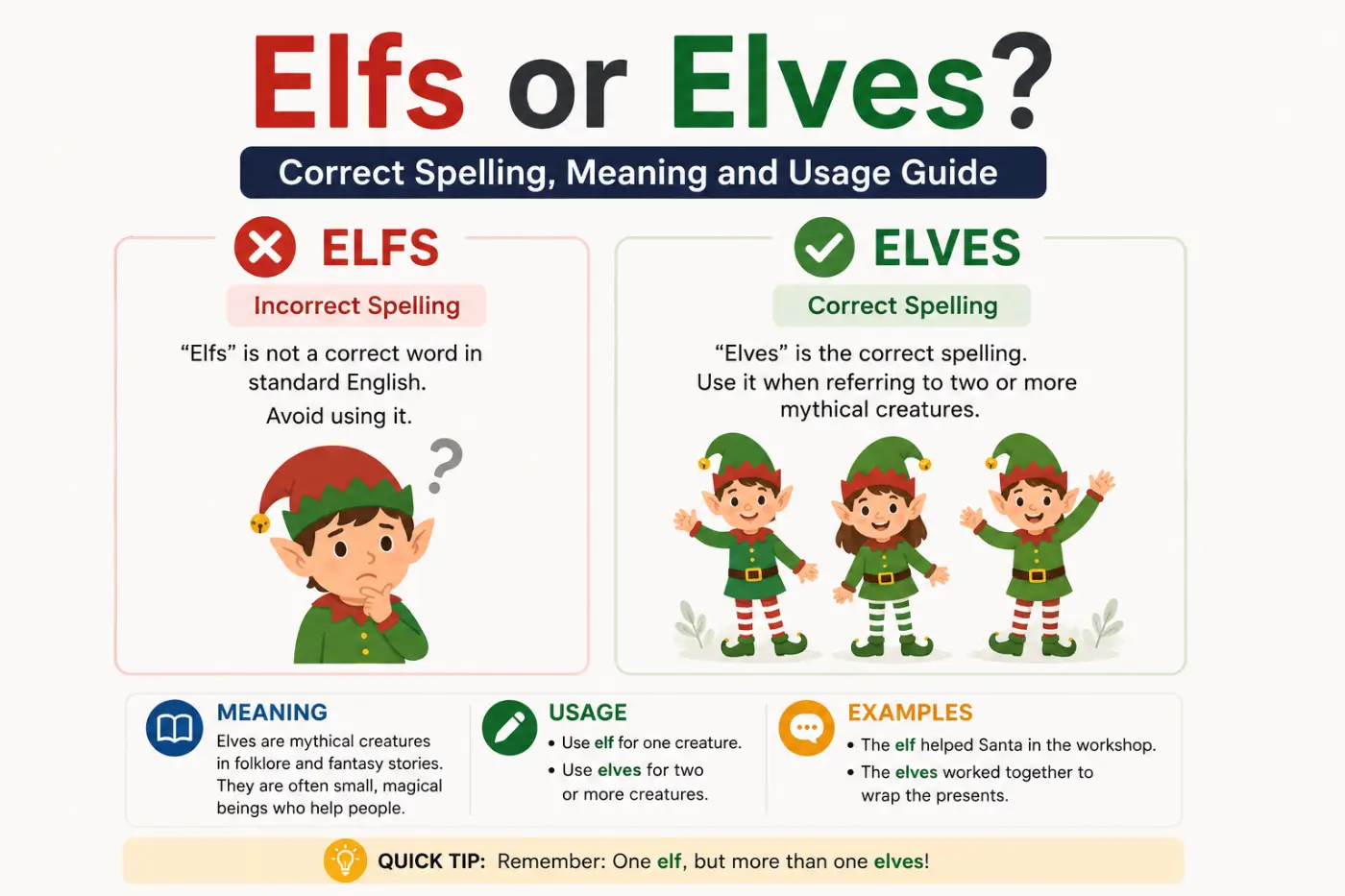
If you’ve ever wondered about elfs or elves while writing about Santa’s helpers or fantasy characters you’re not alone. The correct standard plural is elves. Elfs is a common misspelling that can look logical because many English nouns simply take s when they become plural.
The confusion comes from the spelling pattern used with some nouns that end in f. Words such as leaf become leaves and wolf becomes wolves. Elf follows the same pattern and changes to elves. English does have exceptions such as roof and chief which take s without changing the f.
This guide explains why elves is correct and how the spelling developed. You’ll also learn the meaning pronunciation grammar rules and common mistakes so you can use the word confidently in everyday writing. By the end you’ll know exactly when to use elf and when to use elves.
A related grammar guide is less then or less than Correct Usage Explained.
Quick Definition
The correct plural of elf is elves. Elf is a singular noun for a mythical or imaginary creature while elves refers to more than one. Elfs may appear occasionally in older or unedited writing but modern dictionaries identify elves as the standard plural form.
Quick Answer
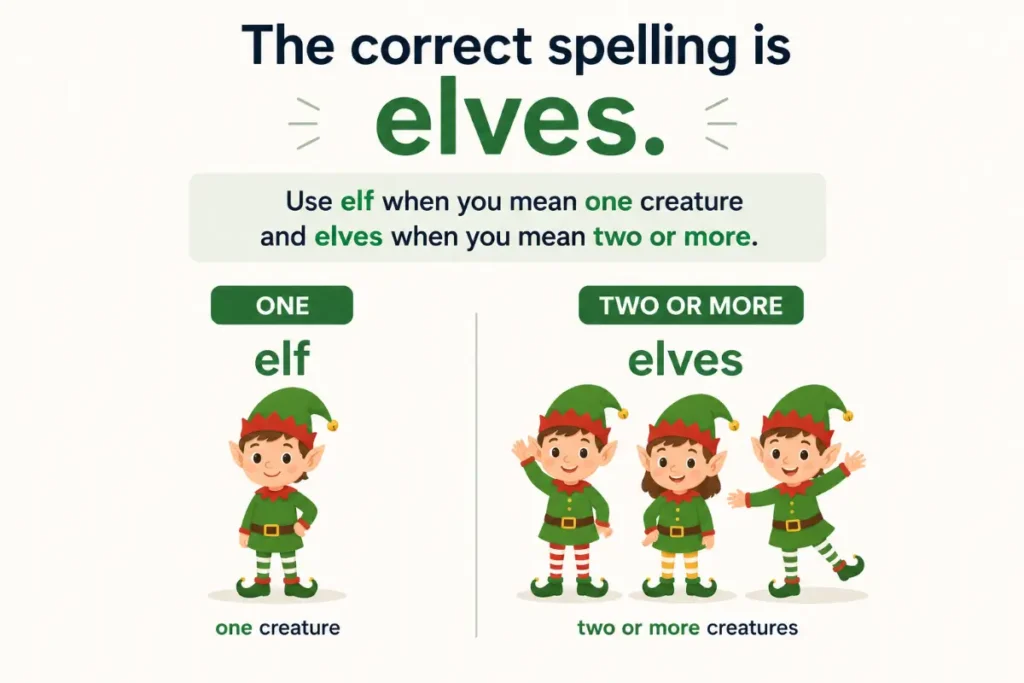
The correct spelling is elves.
Use elf when you mean one creature and elves when you mean two or more. Major dictionaries including Merriam Webster Cambridge and Oxford list elves as the plural.
Comparison Table Elfs or Elves
| Correct Form | Meaning | Part of Speech | Origin | Usage Frequency | Formality | Common Contexts | Example |
|---|---|---|---|---|---|---|---|
| Elves | More than one elf | Plural noun | Old English and Germanic roots | Very common | Standard | Fantasy stories Christmas folklore games | The elves helped Santa prepare the gifts. |
| Elfs | Intended plural of elf but not the standard modern form | Nonstandard plural noun | Historical and occasional English usage | Rare | Nonstandard | Mistakes older texts and occasional specialized use | The writer mistakenly typed elfs instead of elves. |
Meaning and Definition
Meaning of Elfs
Elfs is generally understood as an attempted plural of elf. It isn’t normally treated as the standard plural in modern English. Merriam Webster says that elfs can occasionally be found in print but identifies elves as the accepted modern plural.
That distinction matters because seeing a form in published material doesn’t automatically make it the preferred standard form. English contains many historical spellings and occasional variants that survive in isolated examples.
If you’re writing an email essay article school assignment story or professional document use elves. It’s the form readers expect and the form supported by major modern dictionaries.
You might still encounter elfs in an old text or an unedited online post. In most cases you can treat it as a nonstandard plural rather than a separate everyday word.
There are specialized contexts where similar looking forms can create confusion. For example elve is a different and rare noun referring to a type of atmospheric electrical discharge. Its plural is also elves. That word is unrelated to the ordinary plural question most readers have about elf.
Meaning of Elves
Elves is the plural of elf. An elf traditionally refers to an imaginary or mythical creature often portrayed as small and magical with pointed ears. Modern popular culture gives elves many different appearances and personalities. Some are playful and helpful while others are mysterious or powerful.
The word appears in folklore fantasy literature Christmas stories films games and everyday references to imaginary creatures. In Christmas traditions elves are commonly portrayed as helpers who work with Santa Claus. In fantasy literature they may belong to entire fictional cultures with their own languages histories and societies.
Grammatically elves is a plural count noun. You can say one elf but you normally say two elves or several elves.
For example:
- One elf stood beside the door.
- Two elves carried the boxes.
- The elves worked through the night.
- Several elves appeared in the story.
Oxford lists elves directly as the plural of elf and gives its pronunciation as /elvz/.
Key Differences Explained
- Spelling. Elf changes to elves in the standard plural form. The final f changes to v and the plural ending is added.
- Grammar role. Elf is singular while elves is plural. Elfs is not the standard plural used in modern edited English.
- Meaning. Elf refers to one mythical creature. Elves refers to two or more.
- Tone. Elves works naturally in casual writing formal writing fiction journalism and academic discussion. Elfs can look like a spelling mistake to most readers.
- Context. Use elves when writing about fantasy characters folklore Christmas traditions or fictional worlds. If you’re writing for school work or publication elves is the safe standard choice.
Which Spelling Is Correct
Elves is the correct standard plural of elf.
This isn’t simply a matter of style. Major dictionaries agree on the plural. Merriam Webster lists elf with the plural elves and explains that the form follows a common English pattern found in words such as shelf and calf. Cambridge also lists elves as the plural while Oxford gives elves as the standard plural form.
The spelling also makes sense from a historical language perspective. English inherited old plural patterns from earlier stages of the language. Some nouns ending in f developed a voiced v sound when pluralized. That sound change became reflected in spelling for several common words.
It’s worth remembering that English doesn’t have one perfect rule for every f ending noun. Roof becomes roofs while wolf becomes wolves. Chief becomes chiefs while thief becomes thieves. So you can use the pattern as a useful guide but you still need to learn individual words.
For elf the dictionary answer is clear. Write elves.
Sentence Examples
Here are natural examples showing how elves works in real sentences.
- The elves were busy preparing the gifts.
- Several elves appeared in the fantasy novel.
- The children watched the elves dance around the Christmas tree.
- The story follows a group of elves who live deep inside an enchanted forest.
- Santa’s elves worked late into the night.
- The movie presents the elves as clever and adventurous characters.
- We read stories about elves when we were children.
- The game allows players to create powerful elves with magical abilities.
- The old legend describes elves living near the forest.
- The artist drew three cheerful elves beside a tiny house.
Now compare those examples with the common misspelling.
- The elfs were busy preparing the gifts.
- Several elfs appeared in the fantasy novel.
- The children watched the elfs dance around the tree.
- Santa’s elfs worked late into the night.
- The story includes friendly elfs who protect the forest.
These examples are useful because the meaning remains understandable. The problem is the form. In standard modern English you should replace elfs with elves.
Common Mistakes and Misspellings
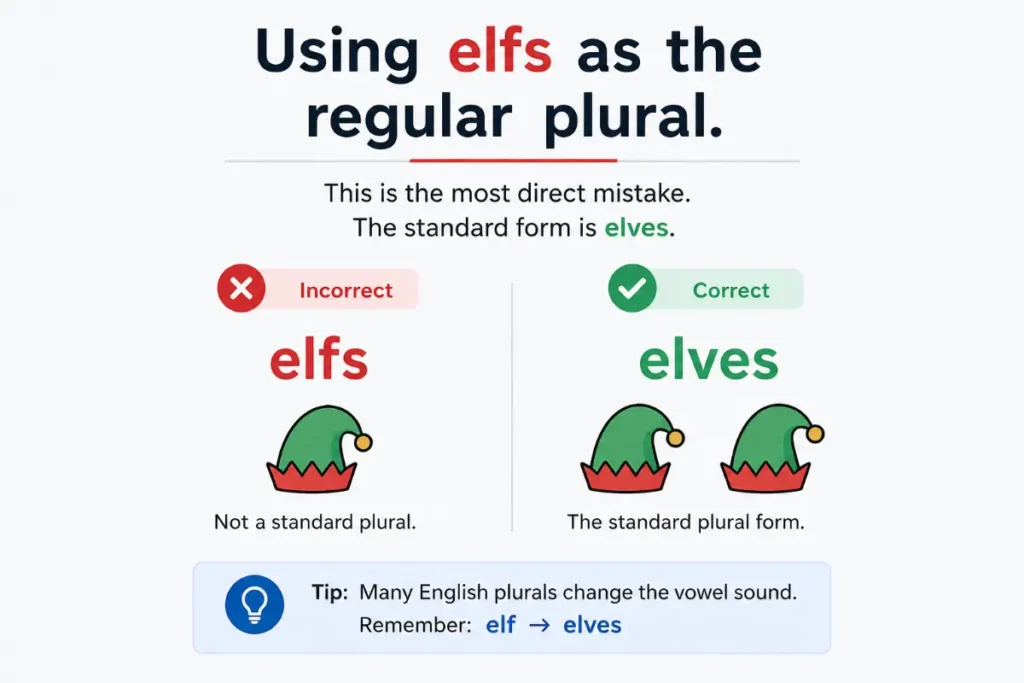
- Using elfs as the regular plural. This is the most direct mistake. The standard form is elves.
- Assuming every f ending noun takes s. English plural formation doesn’t work that neatly. Some nouns take s while others change f to v.
- Confusing spelling with pronunciation. Elves is pronounced /elvz/ rather than like elf with a separate s sound. Cambridge gives /elvz/ for the plural.
- Copying a nonstandard form from online text. Search engines can surface user generated writing containing spelling mistakes. A form appearing online isn’t proof that dictionaries accept it.
- Applying a single rule to every word. English contains many irregular and mixed plural patterns. Words such as roofs and chiefs remind us that spelling patterns have exceptions.
From an NLP perspective the confusion makes sense. Your brain recognizes the base word elf and may automatically attach the familiar plural ending s. That creates elfs. Similar patterns appear when people form plurals such as shelfs or wolfs before remembering the established forms shelves and wolves.
The easiest memory trick is to connect elf with shelf and wolf. If shelf becomes shelves and wolf becomes wolves then elf becomes elves.
You may also want to read gizmo vs gismo: Which Spelling Is Correct?.
Pronunciation Guide
The singular elf is pronounced /elf/. The plural elves is pronounced /elvz/. Cambridge lists the American and British pronunciation of elves as /elvz/.
A simple pronunciation guide is:
- Elf sounds like elf.
- Elves sounds like elvz.
- The final sound is a voiced z sound rather than a separate s sound.
- The plural has one syllable.
Think of the ending in words such as lives and shelves. The final sound is voiced.
A common mistake is to pronounce elves as though it were written elfs. In normal speech the v sound is clear. That distinction can actually help you remember the spelling because the pronunciation points toward the letter v.
Etymology and Word Origin
Elf is an old English word with Germanic roots. Oxford identifies it as Old English and Germanic in origin and connects it with related Germanic words.
Merriam Webster traces the modern noun to Middle English and Old English ælf. It also notes connections with Old Norse alfr and Middle Low German alf. The word has been part of the English language for many centuries.
The plural history is more complicated than simply adding an s. English has inherited several plural patterns from earlier forms of the language. Over time elves became the established modern plural.
Merriam Webster explains that the f to v change follows a broader English pattern found in words such as shelf and calf. It also points out that this pattern has exceptions.
The history of the word also helps explain why spelling can feel less predictable than modern learners expect. English is a layered language. Germanic foundations sit alongside influences from French Latin Norse and many other sources. Plural forms often preserve pieces of that long history.
The result is a word that looks simple today but carries centuries of linguistic development behind it.
Regional Usage US UK AU CA
United States
American English uses elves as the standard plural of elf. The word appears widely in Christmas writing fantasy fiction popular culture gaming and everyday conversation. Cambridge’s American Dictionary lists elves as the plural.
United Kingdom
British English also uses elves as the standard plural. The form is well established in British dictionaries and traditional English usage. You’ll see it in folklore writing literature fantasy and Christmas contexts.
Australia
Australian English follows the standard English plural and uses elves. There is no established Australian spelling variant that replaces elves with elfs in ordinary writing.
Canada
Canadian English also uses elves as the normal plural. Canadian writers generally follow the same standard plural pattern found across major English varieties.
Across these regions the answer stays consistent. Elves is the normal standard form. Elfs may appear as an occasional nonstandard spelling but it isn’t a regional alternative that you should use in standard writing.
Grammar Rules and Part of Speech
Elf is a countable noun. That means you can use a number or quantity word with it.
- One elf.
- Two elves.
- Three elves.
- Several elves.
- Many elves.
When the noun is singular you use elf.
When the noun is plural you use elves.
For example: - The elf is holding a lantern.
- The elves are holding lanterns.
Notice that the verb also changes. The singular subject elf takes is while the plural subject elves takes are.
You can use elves as the subject or object of a sentence.
As a subject:
The elves live in the forest.
As an object:
The children saw the elves.
You can also use possessive forms. - The elf’s hat is red.
- The elves’ hats are red.
The first sentence refers to one elf. The second refers to several elves.
A useful grammar point is that elves doesn’t need an apostrophe simply because it is plural. Apostrophes show possession rather than ordinary plurality.
So write:
The elves are working.
Not:
The elf’s are working.
The apostrophe in elves’ is used only when the plural noun owns something.
For example:
The elves’ workshop was hidden in the forest.
Real Life Usage Examples
Daily Talk
- My kids love stories about elves.
- We saw little elves decorating the store window.
In everyday conversation the word often appears around Christmas or fantasy stories. It can also be used playfully for a person who works quickly or quietly.
- The holiday display includes several elves near the entrance.
- The children’s event will feature elves and other fantasy characters.
In professional email writing the word is perfectly normal when the subject calls for it. The key is context rather than formality.
Academic Writing
- Scholars have examined representations of elves in medieval folklore.
- The novel presents elves as a distinct cultural group within its fictional world.
Academic writing may use the word when discussing mythology folklore literature popular culture or fantasy studies.
News
- Local stores have added displays featuring Santa and his elves.
- The holiday parade will include performers dressed as elves.
News writing uses the standard plural naturally when reporting seasonal events or cultural topics.
Literature
- The elves disappeared beyond the ancient forest.
- The travelers entered a kingdom ruled by elves.
Literary writers have used elves for centuries. The word can suggest folklore magic mystery or an invented fantasy society depending on the setting.
Related and Confused Terms
Several words overlap with elves in meaning or context but they aren’t interchangeable in every sentence.
- Fairies. A broad term for magical or supernatural beings. It can overlap with elves in folklore but describes a different traditional category.
- Goblins. Usually refers to small supernatural creatures often portrayed as mischievous or threatening.
- Pixies. A folklore term associated especially with English traditions.
- Dwarfs. A different noun with its own plural history. In general English dwarfs is standard while dwarves is also strongly established in fantasy contexts.
- Elvish. An adjective or noun associated with elves or their languages and culture.
- Elven. An adjective often used in fantasy literature to describe something connected with elves.
- Fairy folk. A broader phrase for supernatural beings in folklore.
- Little people. A phrase that can refer to supernatural beings in some folklore traditions but can also have other meanings depending on context.
The most useful spelling connection is with words such as leaves shelves wolves and thieves. These words can reinforce the f to v pattern that appears in elves. Merriam Webster specifically discusses this family of plural forms when explaining why elves is preferred.
Expert Editor Insight
As a senior editor I’d treat elves as a straightforward standard form and correct elfs in almost every ordinary piece of modern English. Dictionary evidence is unusually consistent here. Merriam Webster explicitly calls elves the accepted modern plural while Cambridge and Oxford list elves as the plural of elf.
One practical editing tip is to stop trying to create the plural from the singular every time. Instead learn elf and elves as a pair. That approach works better because English has many plural forms that don’t follow one universal rule.
Grammar and spell checking tools will normally flag elfs because it is not the standard plural. Still don’t rely entirely on software. A spell checker can identify a likely error but it won’t always explain the linguistic reason behind the correction.
For writers the cleanest choice is simple. If you mean more than one elf write elves.
Many readers also check Channel Vs Chanel Which One Is Correct? (2026).
Conclusion
If you’re choosing between elfs and elves the answer is clear. Elves is the standard modern plural of elf. Use elf for one creature and elves for two or more. The spelling follows a familiar English pattern in which some f ending nouns change to v before forming the plural.
You can see the same pattern in words such as wolf and wolves or shelf and shelves. The easiest practical tip is to learn the pair together: elf and elves. Once that spelling becomes familiar you won’t need to stop and wonder which form belongs in your sentence.
FAQs
Is elfs a real word?
Elfs can be found occasionally in English texts but it isn’t the accepted modern plural of elf. Major dictionaries list elves as the standard plural. Merriam Webster notes that elfs appears occasionally in print but is widely considered incorrect in edited prose. For school work professional writing and standard English use elves.
What does elves mean?
Elves is the plural of elf. It refers to two or more mythical or imaginary creatures commonly associated with folklore fantasy stories and Christmas traditions. Dictionaries describe elves as plural creatures often portrayed as small magical beings with pointed ears. In modern culture the appearance and personality of elves can vary greatly.
Elfs or elves which is correct?
Elves is correct in standard modern English. It is the established plural form listed by Merriam Webster Cambridge and Oxford. The spelling follows a broader pattern in which some nouns ending in f change the f to v when pluralized. Examples include wolf and wolves plus shelf and shelves. English has exceptions but elf follows the v pattern.
How do you pronounce elves?
Elves is pronounced /elvz/. It has one syllable and rhymes closely with words that end in a voiced vz sound. Cambridge lists /elvz/ for both American and British English. The final sound is voiced rather than the unvoiced s sound you might expect from simply adding s to elf.
Can elves start a sentence?
Yes. Elves can appear at the beginning of a sentence when it functions as the subject or another sentence element. For example you can write Elves appear throughout the story. The plural noun itself follows normal capitalization rules. It doesn’t need a capital letter simply because it refers to mythical creatures.
What is the synonym of elves?
There isn’t one perfect synonym because elves refers to a particular type of mythical creature. Depending on context you might use fairies pixies magical beings or supernatural creatures. These terms carry different cultural meanings so they shouldn’t automatically replace elves. In a fantasy story the exact choice can affect how readers imagine the characters.
Why do people misspell elves?
People often write elfs because adding s is a familiar way to form English plurals. The spelling can feel logical when you start with elf and simply attach the usual plural ending. English also contains f ending nouns that do take s which adds to the confusion. Learning elves as the established plural makes the spelling easier to remember.
Is elves suitable for formal writing?
Yes. Elves is completely appropriate in formal writing when the subject calls for the word. You can use it in academic work literary analysis journalism professional communication and other edited writing. The form is standard English and is supported by major dictionaries. The only issue is context. A formal document should use the word naturally rather than forcing a reference to elves where it doesn’t belong.