
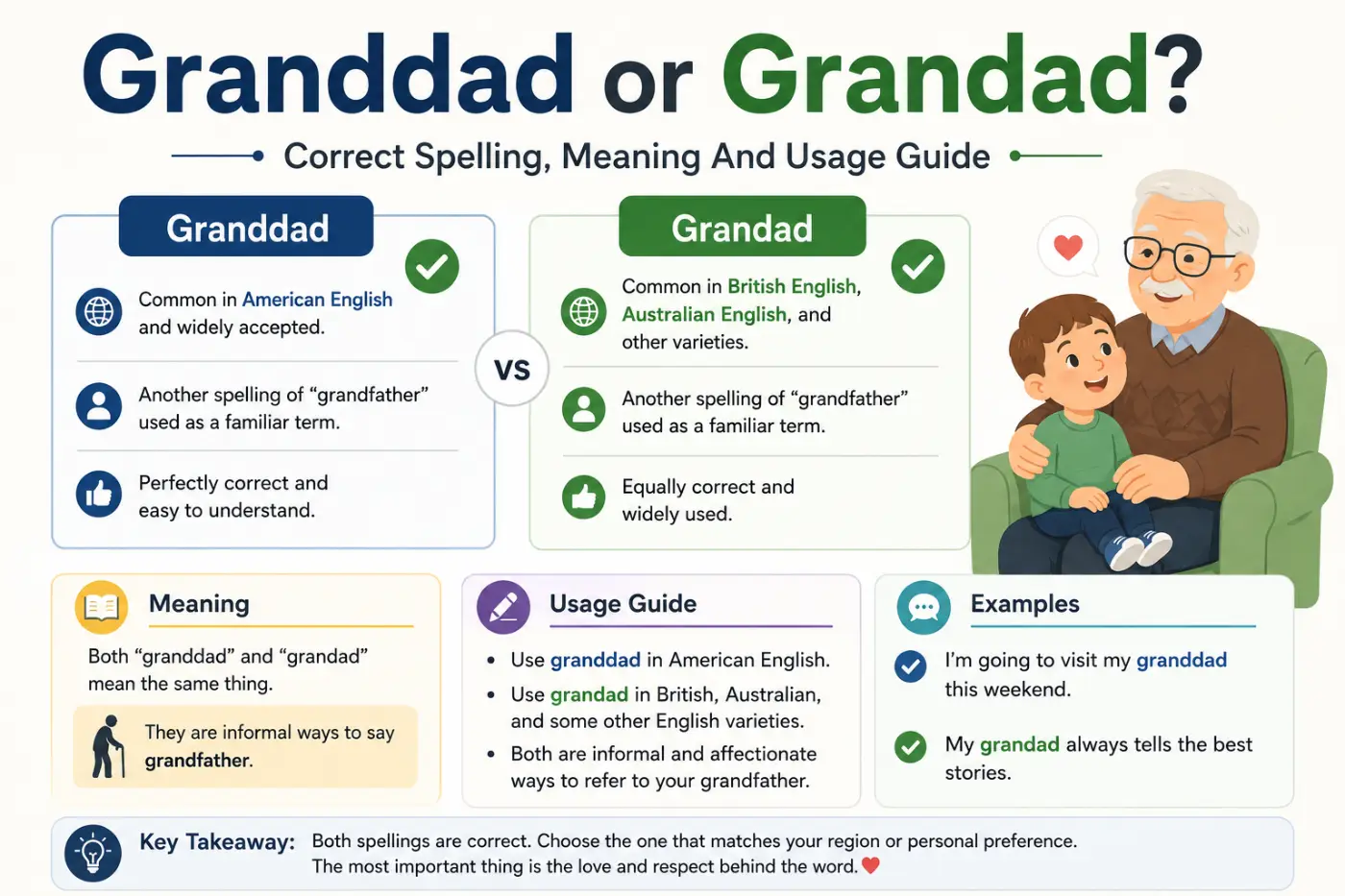
Few family words create as much spelling uncertainty as granddad or grandad. You may see one spelling in a family message and the other in a book or dictionary. Then you may wonder if one is correct and the other is a mistake.
The good news is that both granddad and grandad are correct. They have the same meaning and refer to a grandfather in informal English. The main difference comes from regional preference. Grandad is especially associated with British English while granddad is especially common in North American English. Major dictionaries recognize both forms.
The confusion comes from the way the word combines grand with dad. English speakers naturally use both spellings because dad itself can appear as the second part of family words. Pronunciation also does not clearly tell you which spelling to choose.
In this guide you’ll learn the difference between the two spellings their meaning pronunciation grammar regional usage history and common mistakes. You’ll also see natural examples that show how native speakers use these words in everyday writing.
Learn the difference in dialog vs dialogue Meaning Difference And Usage.
Quick Definition
Granddad and grandad are both correct informal words for grandfather. They have the same meaning and pronunciation. Granddad is especially common in North American English while grandad is strongly associated with British English. Neither spelling is a mistake. Your choice mainly depends on regional preference personal preference and the style of the publication you’re writing for.
Quick Answer
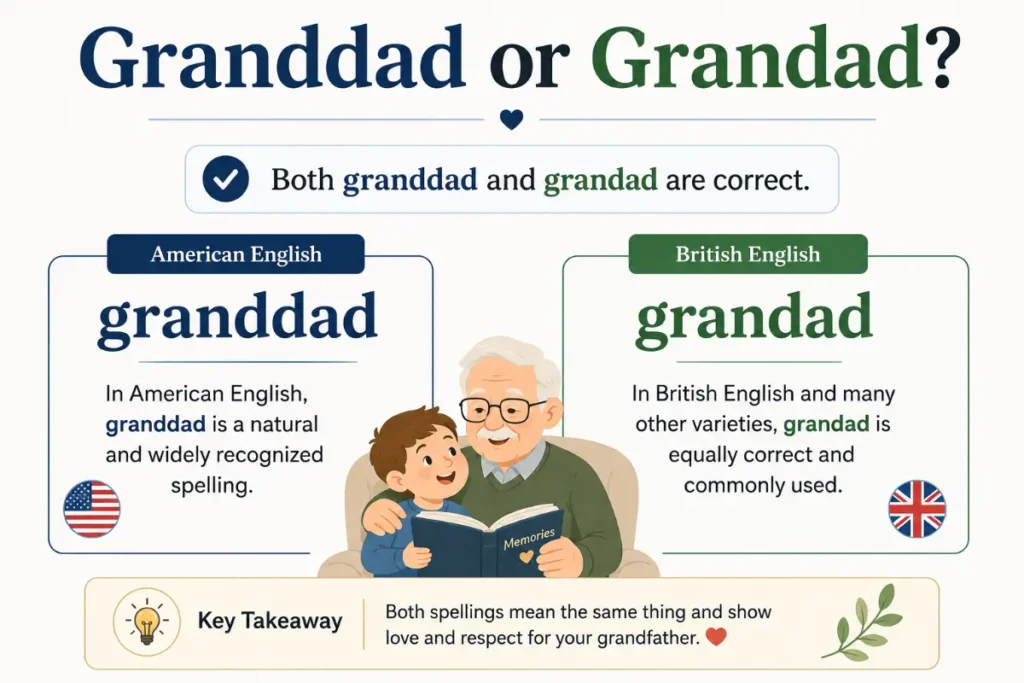
Both granddad and grandad are correct.
In American English granddad is a natural and widely recognized spelling. In British English grandad is especially common. You can use either form when referring informally to your grandfather unless a particular publication or family tradition follows one spelling consistently.
Comparison Table For Granddad Or Grandad
| Correct Form | Meaning | Part of Speech | Origin | Usage Frequency | Formality | Common Contexts | Example |
|---|---|---|---|---|---|---|---|
| Granddad | Informal word for grandfather | Noun | Grand plus dad | Common | Informal | American English family speech personal writing | My granddad taught me how to fish. |
| Grandad | Informal word for grandfather | Noun | Grand plus dad | Common | Informal | British English family speech personal writing | My grandad lives near London. |
Major dictionaries support both forms. Merriam Webster lists grandad as a variant of granddad. Oxford lists grandad and identifies granddad as a form used especially in North American English. Cambridge also recognizes grandad and granddad as forms of the same informal family term.
Meaning And Definition
Meaning Of Granddad
Granddad is an informal noun meaning grandfather. A grandfather is the father of your mother or father. In everyday American English granddad can sound warm familiar and affectionate.
For example you might say My granddad always made pancakes on Sunday.
You might also use the word when talking about a grandfather to another person.
My granddad was a carpenter.
Here granddad has exactly the same basic meaning as grandfather. The difference is tone. Grandfather is more neutral and formal. Granddad is more personal and conversational.
Oxford lists granddad as an informal word meaning grandfather. The Oxford Advanced American Dictionary gives the pronunciation as /ˈɡrændæd/.
Merriam Webster also treats granddad as a standard dictionary word and lists grandad as a variant. That is strong evidence that grandad is not simply an accidental spelling variation. It is an established form in English.
Meaning Of Grandad
Grandad has the same meaning as granddad. It means grandfather and functions as an informal noun.
For example:
My grandad used to tell us stories after dinner.
Grandad is particularly familiar in British English. Cambridge identifies grandad as a UK form and also lists granddad as a related spelling. Oxford likewise identifies grandad as an informal word for grandfather and notes that granddad is especially used in North American English.
So if you are writing for readers in the United Kingdom you’ll often see grandad. If you are writing for a general American audience granddad may feel more natural.
Neither form changes the meaning.
Think of the two spellings as two roads leading to the same place. The destination is grandfather. The spelling simply reflects a regional preference.
Key Differences Explained
Spelling
The most obvious difference is the extra d.
Granddad has two d letters between grand and ad.
Grandad has one d at that point.
Both spellings are established English forms. The difference is not the same as the difference between a correct word and a misspelling.
Grammar Role
Both forms are nouns.
They can work as the subject or object of a sentence.
My granddad loves gardening.
I called my grandad yesterday.
They can also appear after possessive words.
Her granddad lives in Texas.
His grandad worked on a farm.
Meaning
The meaning does not change.
Granddad means grandfather.
Grandad also means grandfather.
Neither spelling refers to a different family relationship.
Tone
Both words are informal.
Grandfather sounds more neutral and formal. Granddad and grandad sound warmer and more personal.
A legal document might use grandfather because it has a more formal tone. A child talking about a family member might naturally say granddad or grandad.
Context
Regional context matters more than grammar.
Granddad fits naturally into American English. Grandad is especially familiar in British English. Both forms can appear in international English and readers will normally understand both without difficulty.
Which Spelling Is Correct
Both spellings are correct.
This is not a case where one form should be labeled wrong. Dictionary evidence supports that conclusion.
Merriam Webster lists granddad as the main entry and identifies grandad as a variant. Oxford gives grandad as an informal noun meaning grandfather and specifically notes granddad as especially common in North American English. Cambridge describes grandad as another UK spelling of granddad.
For American readers I’d generally choose granddad because it fits common American usage naturally. For British readers grandad is often the better choice.
There is one practical rule worth remembering. If you are writing a personal story about your family and your family uses one spelling then keep that spelling. Names and family terms often become part of a family’s own language.
If you are writing professionally choose the spelling that fits your target variety of English and use it consistently.
Sentence Examples
Here are natural examples with granddad.
- My granddad taught me how to ride a bicycle.
- I spent the weekend at my granddad’s house.
- My granddad makes the best apple pie.
- We called our granddad every Sunday evening.
- Her granddad served in the Navy when he was young.
- My granddad always kept old photographs in a wooden box.
- I learned to fish from my granddad.
- His granddad grew up on a small farm.
- My granddad has a great sense of humor.
- The children ran outside when they heard their granddad arrive.
Now look at examples with grandad.
- My grandad taught me how to fix an old bicycle.
- Her grandad lives in Manchester.
- I used to visit my grandad every summer.
- His grandad told him stories about the village.
- Our grandad always made us laugh at family dinners.
These examples show an important point. The sentence structure does not change when you switch between the two spellings.
My granddad lives nearby.
My grandad lives nearby.
Both sentences are grammatically correct.
Common Mistakes And Misspellings
English learners and native speakers can hesitate over this word because the pronunciation gives little help with the spelling. The two forms sound almost identical in ordinary speech.
Here are five common problems.
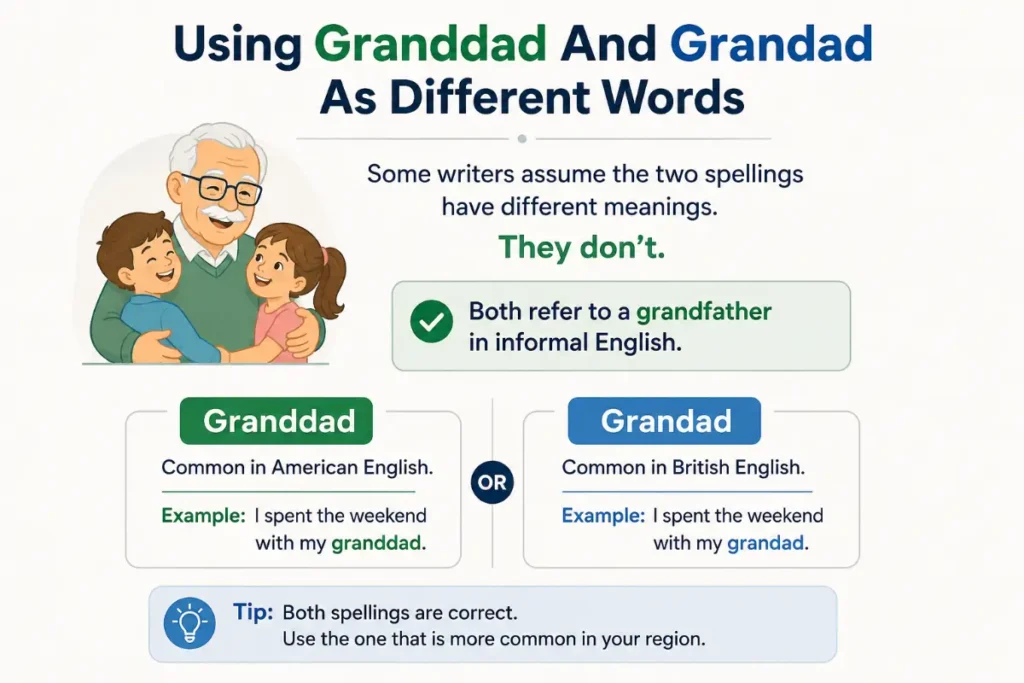
Using Granddad And Grandad As Different Words
Some writers assume the two spellings have different meanings. They don’t.
Both refer to a grandfather in informal English.
Treating Grandad As A Misspelling
This is a common mistake in American focused writing. Grandad is not an accidental deletion of a letter. It is an established dictionary form and is strongly associated with British English.
Treating Granddad As Wrong
The reverse mistake also happens. Some writers know grandad from British English and assume granddad is incorrect. It isn’t. Merriam Webster recognizes granddad and lists grandad as a variant.
Confusing Spelling With Pronunciation
Both forms are pronounced essentially the same way. The extra d in writing does not create another spoken syllable.
Mixing Regional Styles
A document written for an American audience may use granddad in one paragraph and grandad in another. That isn’t a grammar error but it can make the writing look inconsistent.
NLP based spelling tools can also flag unfamiliar variants depending on the dictionary or language setting. A British English dictionary may prefer grandad while an American English dictionary may favor granddad. A spelling warning therefore does not automatically mean the word is wrong.
Pronunciation Guide
Both words are pronounced almost identically.
The common pronunciation is represented in IPA as /ˈɡrændæd/.
You can think of the pronunciation in two parts.
grand dad
The first part sounds like grand.
The second part sounds like dad.
The stress falls on the first syllable.
An easy audio style spelling is GRAND dad.
Cambridge gives granddad as /ˈɡræn d.dæd/ in both UK and US pronunciation listings. Oxford gives grandad as /ˈɡrændæd/.
A common pronunciation mistake is to stretch the word into three syllables. Native speakers generally say it as two syllables.
You do not need to pronounce the extra written d in granddad as a separate sound. The spelling contains a double d but the spoken word does not become grand dad dad.
You may also want to read Well Deserved Meaning Spelling And Usage.
Etymology And Word Origin
The history of this family word is fairly straightforward.
Granddad and grandad developed from the combination of grand and dad. Etymology Online dates grandad to 1793 and notes that granddad is also attested from the eighteenth century. The word grand began developing a special genealogical meaning long before that.
The older element grand originally had a meaning connected with size or importance. Over time English used grand in family relationships to indicate a generation above the immediate parent.
That pattern appears in words such as grandfather and grandmother.
Dad is an informal word for father. Etymology Online records dad from around 1500 and explains that the word probably comes from child speech. Similar forms occur across several languages.
Put the pieces together and the structure becomes easy to understand.
Grand means a generation above.
Dad means father.
Granddad therefore developed as an informal family word for the father of your parent.
The spelling variation is a natural part of English development. One form keeps the full double d structure of granddad while the other simplifies the meeting point between grand and dad.
This is why you shouldn’t think of grandad as a careless shortcut. It has a long history as an established spelling.
Regional Usage In The US
American English commonly uses granddad as an informal word for grandfather. Oxford specifically labels granddad as especially common in North American English. Cambridge also lists granddad in its American English dictionary.
Grandad is still understandable to American readers. It can appear in books personal names family traditions or writing influenced by British English.
For a general American audience I’d usually choose granddad.
If you are writing a family story and the family uses grandad then keep grandad. Natural writing matters more than forcing a regional preference.
Regional Usage In The UK
British English strongly favors grandad.
Cambridge identifies grandad as a UK form and its learner dictionary describes it as another UK spelling of granddad.
Granddad is also understood in Britain and does appear in British writing. It simply does not carry the same regional preference as grandad.
So a British writer might naturally write:
My grandad lives in Leeds.
An American writer might naturally write:
My granddad lives in Chicago.
Both sentences follow standard English grammar.
Regional Usage In Australia
Australian English can use both grandad and granddad. The choice can depend on family preference and exposure to British or American English.
Because Australian English has historically shared many conventions with British English the spelling grandad is familiar. Granddad is also clear and established.
There is no meaning difference between the two.
If your Australian publication has a house style then follow that style. Otherwise consistency matters more than treating one form as universally correct.
Regional Usage In Canada
Canadian English also recognizes both spellings.
Canadian English sits in an interesting position because it shares features with both British and American English. As a result you may encounter grandad and granddad in Canadian writing.
For a Canadian audience either form will normally be understood immediately.
If you’re preparing professional content for Canada choose one form and stay consistent throughout the document. That simple habit keeps your writing polished without turning a small spelling choice into a bigger issue.
Grammar Rules And Part Of Speech
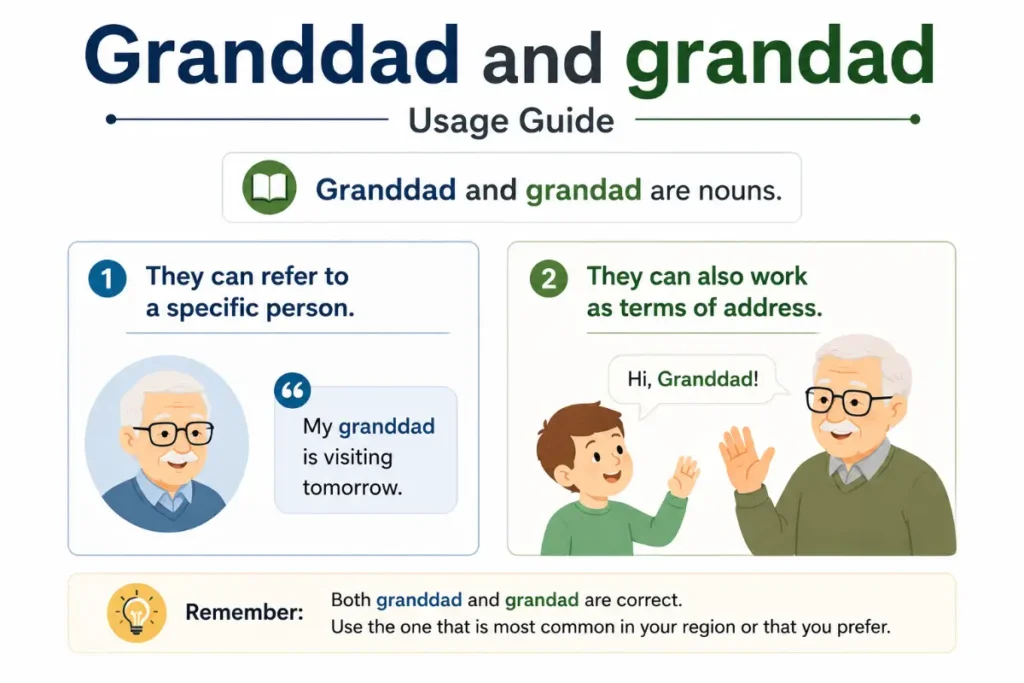
Granddad and grandad are nouns.
They can refer to a specific person.
My granddad is visiting tomorrow.
They can also work as terms of address.
Thanks for helping me, Granddad.
When a family title is used as a direct form of address it can be capitalized.
For example:
Good morning, Granddad.
The word is capitalized because you are using it like a name.
But when you simply describe the relationship it is normally lowercase.
My granddad is visiting.
This distinction is useful in emails cards stories and family histories.
Possessive forms also work normally.
My granddad’s car is old.
My grandad’s stories were always funny.
The apostrophe s shows possession. The spelling of the base word does not change.
The plural form is also straightforward.
Granddads and grandads.
For example:
The two granddads watched the children play.
The three grandads met at the school event.
If you need a formal term use grandfather.
Granddad and grandad are informal. Grandfather is the safer choice in academic writing legal writing formal reports and situations where a neutral family term is preferred.
Real Life Usage Examples
Daily Talk
My granddad is coming over for dinner tonight.
I’m going to visit my grandad this weekend.
These sentences sound natural in casual conversation. The choice depends largely on the speaker’s regional variety and family preference.
I’m taking Friday off to visit my granddad.
My grandad recently celebrated his eightieth birthday.
In a personal email either form works perfectly. A formal business email would usually use grandfather if the relationship needs to be mentioned at all.
Academic Writing
The participant described his grandfather as an important influence during childhood.
Academic writing normally favors grandfather because it maintains a neutral tone. That doesn’t make granddad or grandad grammatically wrong. It simply makes grandfather a better stylistic choice for formal prose.
News Writing
The article reported that the child had been visiting his granddad during the summer.
News writing may use informal family terms when they appear in a quotation or personal account. Outside those contexts editors often prefer grandfather for a neutral tone.
Literature
The old man reminded her of her grandad.
A novelist might choose grandad because the word helps establish a character’s voice or regional background.
Family vocabulary can carry personality. A single word can quietly tell readers something about where a character comes from and how that character speaks.
Related And Confused Terms
Several words and phrases can appear alongside granddad and grandad.
- Grandfather refers to the father of your mother or father and is the standard neutral term.
- Grandpa is another common informal term for grandfather. Cambridge lists it as an informal synonym.
- Granddaddy is a longer informal form that is especially familiar in North American English. Oxford lists it as an informal North American form of grandfather.
- Gramps is a very informal family term for grandfather.
- Grandparent refers to either a grandfather or grandmother.
- Great grandfather refers to the grandfather of one of your parents.
- Grandmother refers to the mother of your mother or father.
- Grandchild refers to the child of your son or daughter.
These terms belong to the same family vocabulary but they do not all have the same level of formality.
Expert Editor Insight
As an editor I’d treat granddad and grandad as legitimate regional variants rather than correcting one into the other automatically. Dictionary evidence matters here because both forms have established entries and usage histories. Merriam Webster lists grandad as a variant of granddad while Oxford and Cambridge clearly recognize both forms.
My practical tip is simple. Decide who your readers are before choosing the spelling. For an American audience granddad is a strong default. For a British audience grandad is often the natural choice. Then keep the spelling consistent. Good editing isn’t about making every writer use one form. It’s about choosing the form that fits the audience and preserving consistency.
Still confused? Compare Natzi or Nazi Meaning, Usage, and Correct Form 2026.
Final Verdict On Granddad Or Grandad
Granddad and grandad are both correct. They mean the same thing and function as informal nouns meaning grandfather. The main difference is regional preference. Granddad is especially common in North American English while grandad is particularly associated with British English.
If you’re writing for an American audience granddad is a natural choice. If you’re writing for a British audience grandad may fit better. Neither spelling is a mistake.
The easiest tip to remember is this. Granddad has two ds while grandad has one but both lead to the same meaning. Choose the form that matches your audience or your family’s preferred spelling and use it consistently.
FAQs
Is Grandad A Real Word?
Yes. Grandad is a real and established English word. It is an informal noun meaning grandfather. Cambridge identifies it as a UK spelling of granddad while Oxford lists it as an informal noun and notes that granddad is especially common in North American English. So grandad is not a typo or an incomplete spelling. It is a legitimate regional form.
Is Granddad A Real Word?
Yes. Granddad is a standard English word meaning grandfather. Merriam Webster lists granddad as a noun and identifies grandad as a variant. Oxford also recognizes granddad as an especially common North American form. It is informal rather than incorrect. American writers can use granddad naturally in conversations personal stories emails and other casual contexts.
Granddad Or Grandad Which Is Correct?
Both are correct. The main difference is regional preference rather than meaning. Granddad is especially common in North American English while grandad is strongly associated with British English. If you’re writing for American readers granddad is usually the natural choice. If you’re writing for British readers grandad will often sound more familiar.
How Do You Pronounce Granddad?
Granddad is pronounced approximately as GRAND dad. The IPA pronunciation is /ˈɡrændæd/. Cambridge gives UK and US pronunciations that are essentially the same. The word normally has two syllables with stress on the first syllable. Grandad has the same basic pronunciation. The spelling difference does not create a meaningful difference in spoken English.
Can Granddad Start A Sentence?
Yes. Granddad can start a sentence when it functions as the subject or as a direct form of address. For example Granddad is coming over tonight. You can also write Good morning, Granddad. When the word is used as a direct form of address it is commonly capitalized. When it simply describes a relationship it is usually lowercase.
What Is A Synonym For Granddad?
Common synonyms include grandfather grandad grandpa granddaddy and gramps. The most neutral option is grandfather. Grandpa and granddad are informal and familiar. Grandad is especially associated with British English. Granddaddy is also informal and has strong North American usage. Gramps is particularly casual and often carries a warm family tone.
Why Do People Spell Granddad As Grandad?
People use grandad because it is an established spelling rather than because they have forgotten a letter. The form is particularly associated with British English. English often develops regional spelling preferences that remain correct even when another region favors a different form. Dictionary evidence confirms that grandad and granddad refer to the same family relationship.
Is Granddad Suitable For Formal Writing?
Granddad is grammatically correct but it is informal. In formal writing grandfather is usually the better choice because it sounds neutral and professional. In personal writing such as family histories personal essays letters and informal emails granddad can sound more natural. The same principle applies to grandad. Choose the word based on the tone and audience rather than treating the informal form as an error.