
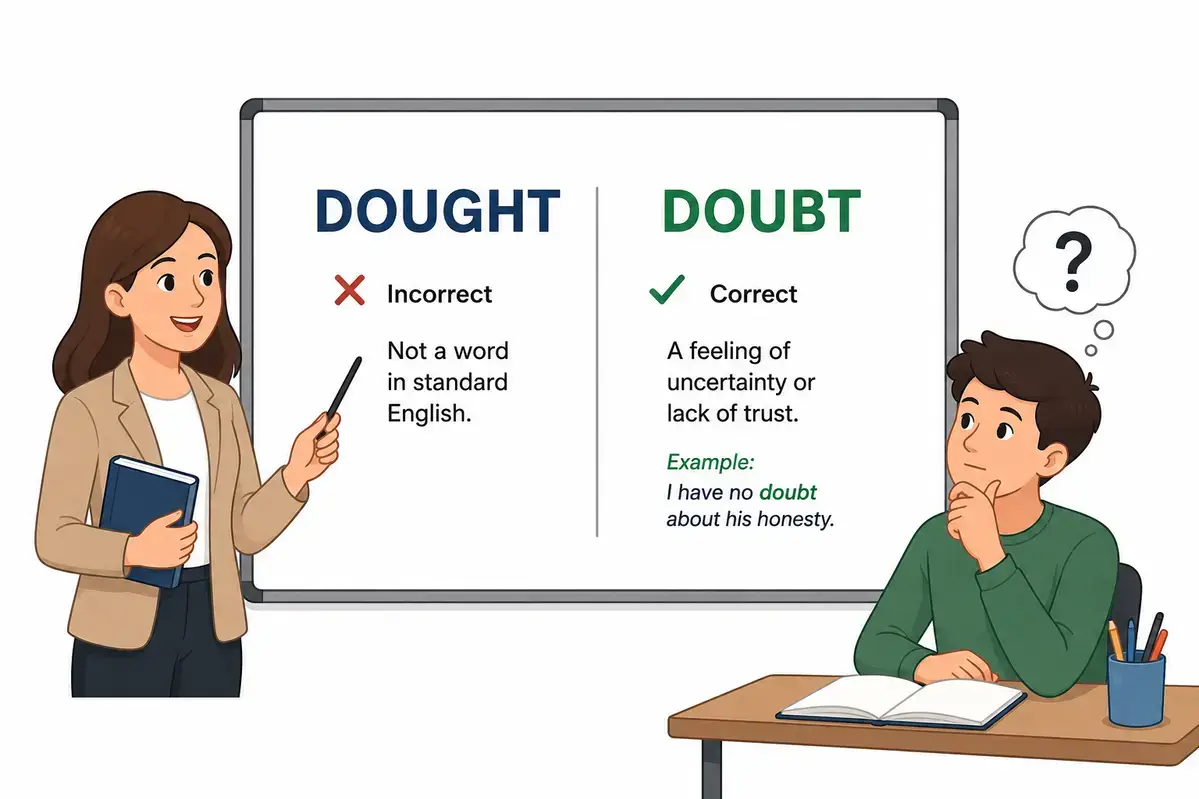
If you searched for dought vs doubt, you’re almost certainly trying to figure out which spelling is correct. The short answer is simple. Doubt is the correct English word. Dought is not recognized as a standard English word in modern dictionaries and is almost always a spelling mistake.
The confusion makes sense. English has many words with silent letters, unusual spellings, and old forms that still appear in names or historical texts. At a quick glance, dought looks like it could belong beside words like thought, fought, or bought. That visual pattern tricks many writers into adding an extra letter where it does not belong.
Professional editors see this kind of mistake every day. Most people don’t misunderstand the meaning of the word. They simply type too quickly or rely on memory instead of checking the spelling. Spellcheck usually catches the error, but not every writing tool does. That is why this mistake still appears in emails, blog posts, social media comments, and even published articles.
This guide explains the correct spelling, meaning, pronunciation, grammar, history, real life usage, and the most common mistakes. By the end, you’ll know exactly when to use doubt and why dought has no place in standard English writing.
Still confused? Compare good luck in future endeavors Meaning and Usage.
Quick Definition
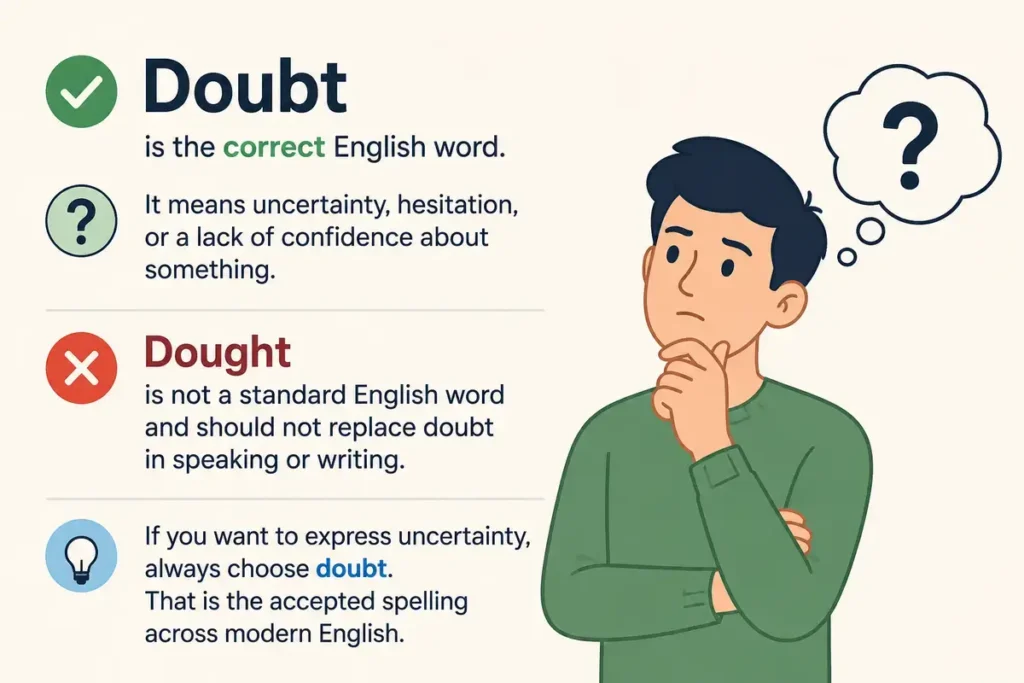
Doubt is the correct English word. It means uncertainty, hesitation, or a lack of confidence about something. Dought is not a standard English word and should not replace doubt in speaking or writing. If you want to express uncertainty, always choose doubt. That is the accepted spelling across modern English.
Quick Answer
The correct spelling is doubt.
Use doubt when talking about uncertainty, suspicion, hesitation, or a lack of belief. Avoid dought because it is considered a spelling error in modern English. Every major dictionary, style guide, and professional editor recognizes doubt as the standard form.
Dought Vs Doubt Comparison
| Feature | Dought | Doubt |
|---|---|---|
| Correct form | No | Yes |
| Meaning | No accepted modern meaning | Uncertainty or lack of confidence |
| Part of speech | Not a standard English word | Noun and verb |
| Origin | Misspelling created by analogy with similar spellings | From Old French and Latin |
| Usage frequency | Extremely rare | Very common |
| Formality level | Not accepted | Suitable in every writing style |
| Common contexts | Typing mistake | Conversation academic writing journalism business legal writing literature |
| Example | Incorrect I dought the answer. | Correct I doubt the answer. |
Meaning Of Dought
Modern English does not recognize dought as a standard word.
Most dictionaries do not include it because it has no accepted meaning in current English. In nearly every case, people who write dought actually mean doubt.
The mistake usually happens because English contains many familiar words ending in ought. Writers subconsciously copy that spelling pattern and produce a word that looks believable but is still incorrect.
From an editorial point of view, dought should always be corrected unless it appears inside a historical document, a family name, or a direct quotation that preserves the original spelling.
Meaning Of Doubt
Doubt is a common English word that functions as both a noun and a verb.
As a noun, it describes uncertainty or a lack of confidence.
Examples include.
- I have no doubt about her ability.
- His answer raised serious doubt.
As a verb, it means to question something or feel uncertain.
Examples include.
- I doubt the story is true.
- She doubts that the plan will work.
The word appears in everyday conversation, professional communication, academic writing, journalism, legal documents, literature, and scientific research. It is one of the most frequently used words for expressing uncertainty in English.
Dought Vs Doubt Key Differences
Although the two spellings look similar, they are not interchangeable.
Meaning
Doubt expresses uncertainty, hesitation, disbelief, or suspicion.
Dought has no accepted meaning in modern English.
Grammar
Doubt works as both a noun and a verb.
Dought does not belong to modern English grammar.
Dictionary Status
Every respected English dictionary lists doubt.
Modern dictionaries do not recognize dought as a standard spelling.
Professional Writing
Editors, teachers, publishers, and style guides all accept doubt.
They treat dought as a spelling mistake.
Everyday Usage
Native speakers naturally write and say doubt.
Very few people intentionally write dought. When it appears, it is almost always accidental.
Which One Is Correct
The answer is clear.
The correct spelling is doubt.
You should use it in every kind of writing, including.
- School assignments.
- College essays.
- Business emails.
- Research papers.
- Books.
- Newspapers.
- Website content.
- Social media posts.
- Legal documents.
- Everyday conversations.
Professional editors rarely stop to think about this spelling because they have seen it thousands of times. Familiarity builds confidence. Readers instantly recognize doubt, while dought looks unusual and distracting. One extra letter can make polished writing appear careless. That is why proofreading matters, even for experienced writers.
Pronunciation Guide
Correct pronunciation helps reinforce the correct spelling.
Doubt
IPA pronunciation.
/daʊt/
Syllable breakdown.
doubt
One syllable.
The letter b is silent.
The pronunciation sounds like dowt.
Common mistakes include pronouncing the silent b or assuming the spelling should match the sound. English contains many silent letters, and doubt is one of the best known examples.
Why The Silent B Exists
Many learners wonder why English keeps a letter that nobody pronounces.
The answer comes from history.
Centuries ago, scholars restored silent letters to show the connection between English words and their Latin ancestors. In the case of doubt, the silent b reflects its relationship with the Latin word dubitare. The pronunciation changed over time, but the spelling remained. English preserves many historical spellings even after the sounds disappear. That explains why the word looks different from how it sounds.
Common Pronunciation Mistakes
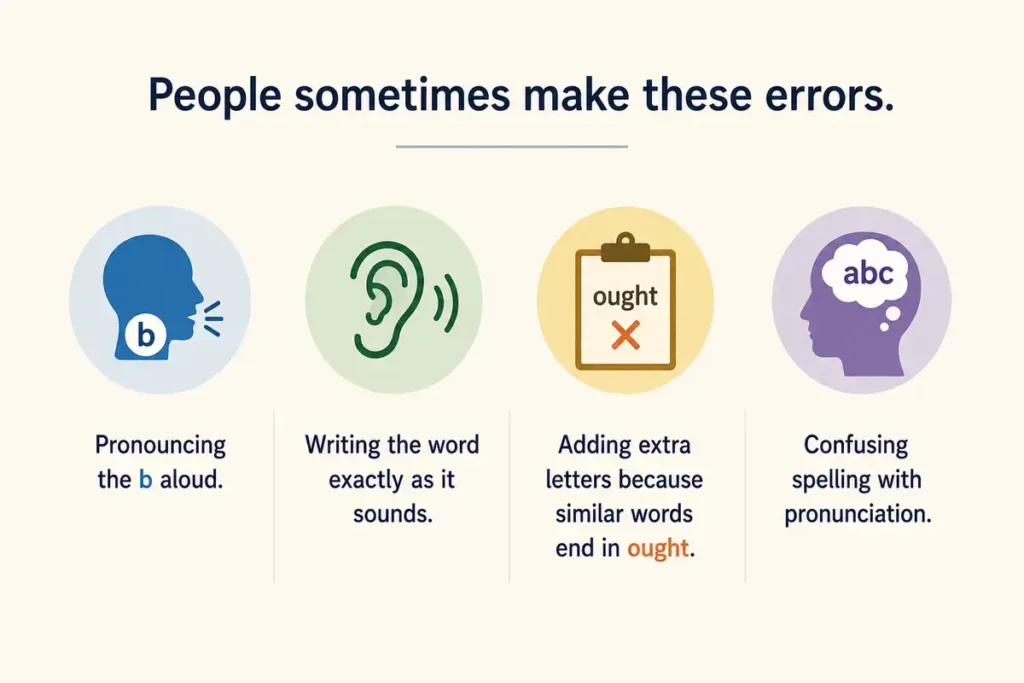
People sometimes make these errors.
- Pronouncing the b aloud.
- Writing the word exactly as it sounds.
- Adding extra letters because similar words end in ought.
- Confusing spelling with pronunciation.
A useful memory trick is simple. You never hear the b, but you always write it.
Grammar Rules For Doubt
Understanding grammar makes the word much easier to use correctly.
As A Noun
The noun refers to uncertainty or hesitation.
Examples.
- There is no doubt about the result.
- Her explanation removed every doubt.
As A Verb
The verb expresses uncertainty or disbelief.
Examples.
- I doubt he forgot the meeting.
- They doubt the report is accurate.
Common Sentence Patterns
You can naturally use the word in structures like these.
- Doubt something.
- Doubt someone.
- Have doubt.
- Have no doubt.
- Beyond doubt.
- Without doubt.
- Cast doubt on.
- Raise doubt about.
These expressions appear regularly in both formal and informal English.
Parts Of Speech
The word serves more than one grammatical role.
Noun
It names a feeling of uncertainty.
Example.
The delay caused doubt among investors.
Verb
It describes questioning or not believing something completely.
Example.
Many people doubt the rumor.
Because it works in both roles, the word is flexible and appears naturally in almost every type of writing.
Common Grammar Mistakes
Professional editors often correct mistakes like these.
- Writing dought instead of doubt.
- Pronouncing the silent b.
- Using the noun when the verb fits better.
- Forgetting that doubt can express polite disagreement.
For example.
I doubt that is correct.
This sounds softer and more natural than directly saying someone is wrong.
For another common grammar confusion, see Forteen Vs Fourteen Which Spelling Is Correct.
Editor Insight
After reviewing thousands of articles, business documents, student papers, and website pages, one pattern appears again and again. Most spelling mistakes are not caused by poor vocabulary. They happen because the eyes see familiar letter patterns and the brain fills in the rest. That is exactly why dought appears from time to time.
Experienced editors do not rely only on memory. They rely on careful proofreading. Even skilled writers make typing mistakes. The difference is that they catch them before anyone else does. Keeping that habit will improve your writing far more than memorizing long lists of spelling rules.
Dought Vs Doubt Examples In Sentences
Seeing words in real sentences makes the correct spelling much easier to remember. The examples below show natural English that you could hear in daily life or read in professional writing.
Examples Using Dought
The following sentences show the incorrect spelling. They reflect mistakes that sometimes appear online.
- I dought he will arrive before noon.
- She had no dought about the decision.
- They dought the report was accurate.
- His dought disappeared after seeing the evidence.
- We dought the weather would improve.
- The teacher corrected every instance of dought in the essay.
- Many people accidentally type dought instead of the correct word.
- Spellcheck quickly highlighted dought as an error.
- The editor replaced dought throughout the document.
- Beginners often confuse dought with the correct spelling.
Every sentence above contains a spelling mistake. Replace dought with doubt to make each sentence correct.
Examples Using Doubt
These examples show the correct spelling in natural English.
- I doubt he forgot the appointment.
- She had no doubt about her answer.
- They doubt the rumor is true.
- His doubt disappeared after reading the report.
- We doubt the package will arrive today.
- The manager never doubted her ability to lead the team.
- There is little doubt that practice improves writing.
- The evidence removed every doubt from the investigation.
- Few people doubt the value of careful proofreading.
- She spoke with confidence and left no doubt about her decision.
These examples reflect the way native speakers use the word every day.
Common Mistakes
Spelling mistakes often follow predictable patterns. Once you understand those patterns, they become much easier to avoid.
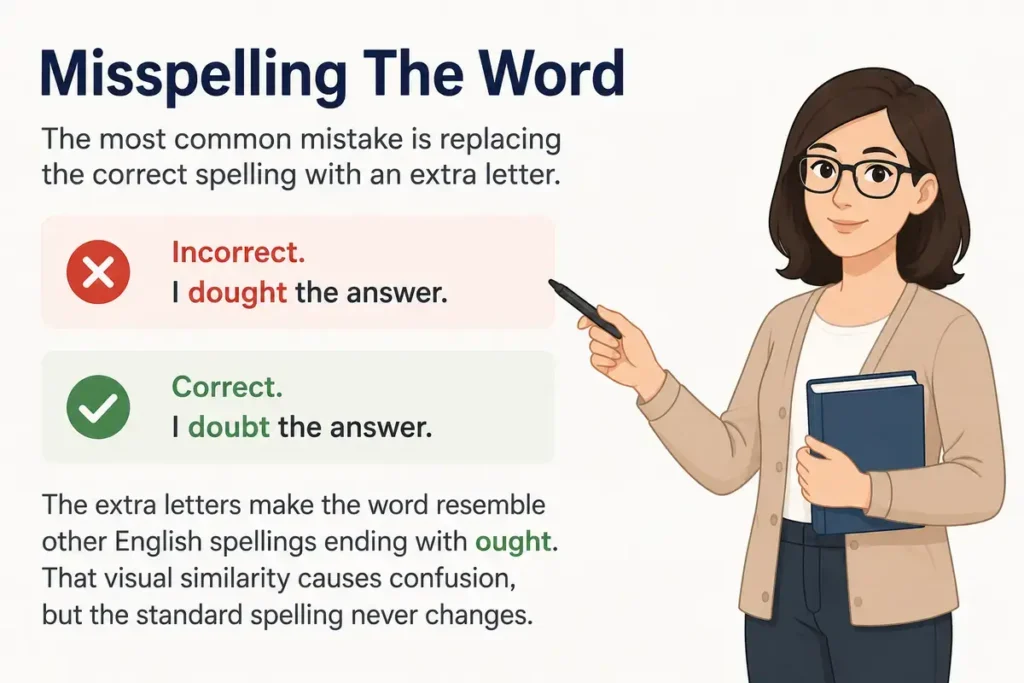
Misspelling The Word
The most common mistake is replacing the correct spelling with an extra letter.
Incorrect.
I dought the answer.
Correct.
I doubt the answer.
The extra letters make the word resemble other English spellings ending with ought. That visual similarity causes confusion, but the standard spelling never changes.
Trusting Pronunciation Too Much
English spelling does not always match pronunciation. Since the b is silent, some writers assume they should change other letters to fit the sound. That approach leads to incorrect spellings. Learning the accepted spelling is far more reliable than writing a word exactly as it sounds.
Ignoring Spellcheck Warnings
Modern writing tools usually recognize the error immediately. Still, people sometimes dismiss the warning without checking the suggestion. A quick review before publishing can prevent this simple mistake.
Copying Incorrect Online Content
Not everything on the internet is accurate. Once a spelling mistake appears on a website, it can spread through blogs, forums, and social media. Always rely on trusted dictionaries and respected style guides instead of assuming every online example is correct.
Why People Confuse These Words
The confusion is understandable because English contains many familiar words ending with similar letter patterns.
Consider these examples.
- Thought.
- Bought.
- Fought.
- Brought.
- Ought.
After seeing these spellings for years, the brain naturally expects another similar pattern. That expectation sometimes changes doubt into an incorrect form.
Another reason is typing speed. Many people know the correct spelling but press the wrong keys while writing quickly. They notice the mistake only after proofreading. Professional editors see this every day. Most spelling errors come from habit rather than a lack of knowledge.
Etymology And Word Origin
The history of a word often explains its unusual spelling. The English word doubt traces its roots through several languages.
- It comes from the Latin verb dubitare, meaning to hesitate or be uncertain.
- It passed into Old French as doute.
- Middle English later adopted the word with a similar meaning.
- Scholars eventually restored the silent b to reflect its Latin origin.
Although pronunciation continued to change, the spelling remained. That historical connection explains why modern English still writes a silent letter that speakers no longer pronounce. This pattern appears in many English words with Latin roots.
How The Meaning Has Changed
The central meaning has remained remarkably stable for centuries. Early writers used the word to describe uncertainty, hesitation, suspicion, or indecision. Modern English still uses it in exactly the same way.
That consistency makes it one of the more dependable words in the language. Unlike many English terms that develop several unrelated meanings over time, doubt continues to express uncertainty in almost every context.
Regional Usage
One useful fact about this word is its consistency across English speaking countries. Unlike words such as color and colour or center and centre, this spelling does not change from one region to another.
American English
American English always uses doubt. The spelling appears in schools, newspapers, government documents, academic writing, and business communication.
British English
British English also uses doubt.
No accepted alternative spelling exists.
Australian English
Australian writers follow the same spelling.
You will see it in books, journalism, universities, and professional documents.
Canadian English
Canadian English uses doubt as well.
Although Canadian spelling sometimes follows British conventions and sometimes American conventions, this word stays exactly the same. This worldwide consistency makes it easier to remember. If you are writing in English, the correct spelling never changes.
Grammar Rules That Matter
Understanding grammar helps you choose the correct sentence structure naturally.
Doubt As A Noun
The noun names a feeling or state.
Examples.
- Her answer removed every doubt.
- There is no doubt about the result.
- His doubt lasted only a few minutes.
Doubt As A Verb
The verb describes uncertainty.
Examples.
- I doubt the meeting will start on time.
- She doubts his explanation.
- We doubt the rumor is true.
Common Expressions
Native speakers regularly use these phrases.
- No doubt.
- Beyond doubt.
- Without doubt.
- Cast doubt on.
- Raise doubt about.
- In doubt.
Learning these expressions helps your writing sound more natural.
Real Life Usage Examples
Professional writers rely on this word in many different situations.
Daily Conversation
I doubt it will rain today.
There is no doubt she will call later.
Academic Writing
Researchers expressed doubt about the original conclusion until additional evidence became available.
Professional Communication
The audit raised doubt about the accuracy of several financial records.
Literature
Novelists often use the word to show hesitation, inner conflict, or emotional uncertainty.
A single sentence expressing doubt can reveal far more about a character than pages of description.
News And Media
Journalists frequently use the word when discussing investigations, public opinion, legal cases, scientific discoveries, and political statements.
The word allows reporters to describe uncertainty without making unsupported claims.
Why Editors Prefer Precision
Editors pay close attention to words that express certainty and uncertainty.
- Choosing the correct term shapes how readers understand a sentence.
For example:
- There is no doubt the project succeeded.
- This sentence communicates confidence.
Now compare it with this:
It is also about choosing language that accurately reflects the intended meaning. Some experts doubt the results. The meaning changes completely because the word signals uncertainty instead of confidence. Professional editing is not only about correcting spelling.
Related Words And Frequently Confused Terms
Expanding your vocabulary makes it easier to understand how this word fits into everyday English.
Similar Words
- Uncertainty.
- Hesitation.
- Suspicion.
- Skepticism.
- Disbelief.
- Question.
- Concern.
- Confusion.
- Mistrust.
- Indecision.
Each word shares part of the same idea but carries a slightly different shade of meaning.
Opposite Words
- Certainty.
- Confidence.
- Assurance.
- Conviction.
- Trust.
- Belief.
- Faith.
- Proof.
These words express confidence instead of uncertainty.
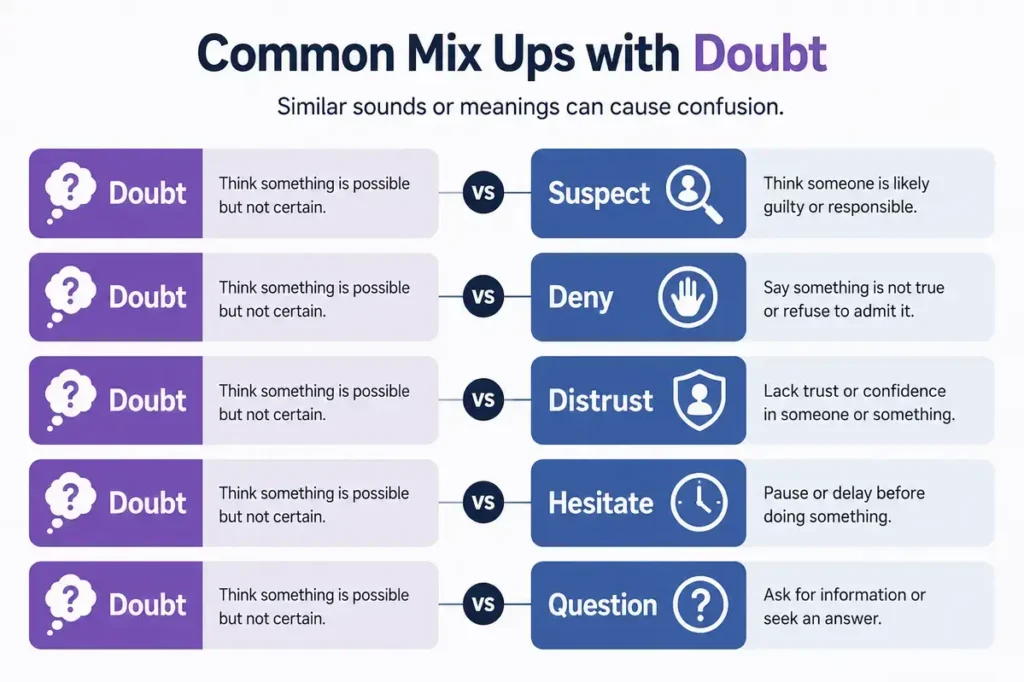
Commonly Confused Words
Some learners also mix doubt with other English words because of pronunciation or meaning.
- Doubt and suspect.
- Doubt and deny.
- Doubt and distrust.
- Doubt and hesitate.
- Doubt and question.
Although they overlap in some situations, each word has its own meaning and usage.
Expert Language Insight
Years of editing reveal an interesting pattern. Native speakers almost never stop to think about the spelling of doubt. They have seen it so many times that the correct form feels automatic. Learners often approach the word differently. They focus on pronunciation first and spelling second. That strategy works for many languages, but English does not always reward it.
Words with silent letters must be learned as complete spelling patterns. Once you recognize doubt as a single familiar word instead of sounding it out letter by letter, the mistake becomes much less likely. That is one reason experienced editors recommend reading regularly. Every page strengthens your memory of correct spelling without turning grammar into a list of rules to memorize.
You may also want to read Prooving vs Proving Which Spelling Is Correct 2026.
Final Thoughts
The answer is straightforward.
Doubt is the correct spelling. It is the only accepted form in modern English and appears in every respected dictionary, style guide, and professional publication. Dought is not recognized as a standard English word and should be treated as a spelling mistake in almost every situation.
The confusion usually comes from English spelling patterns rather than grammar. Words like thought, bought, and fought make the incorrect form look believable at first glance. Once you understand the history of the word and remember that the b is silent, the correct spelling becomes much easier to recall.
Professional editors rarely rely on guesswork. They trust established dictionaries, consistent proofreading, and repeated exposure to correct English. That same habit will strengthen your own writing over time.
If you remember only one lesson from this guide, make it this.
When you want to express uncertainty, hesitation, or a lack of confidence, always write doubt. It is the correct spelling in every variety of modern English and the one your readers expect to see.
Frequently Asked Questions
Is doubt the correct spelling?
Yes. Doubt is the correct spelling in modern English. It works as both a noun and a verb and appears in every major English dictionary. The spelling stays the same in American English, British English, Australian English, and Canadian English.
Is dought a real English word?
No. Dought is not a standard English word. In almost every situation, it is simply a misspelling of doubt. If you see it in modern writing, it should usually be corrected unless it appears in a historical source, a proper name, or an exact quotation.
Why is the letter b silent in doubt?
The silent b comes from the word’s Latin origin. English scholars restored the letter centuries ago to reflect its connection with the Latin word dubitare. Although pronunciation changed over time, the spelling remained the same.
How do you pronounce doubt?
The IPA pronunciation is /daʊt/. It has one syllable, and the b is completely silent. It sounds like dowt, even though the silent letter remains in the written form.
Can doubt be used as both a noun and a verb?
Yes. As a noun, it refers to uncertainty or hesitation. As a verb, it means to question or feel uncertain about something. Both uses are common in everyday conversation, academic writing, business communication, and literature.
Is there a British spelling of doubt?
No. English speaking countries all use the same spelling. Unlike words such as color and colour, doubt does not have regional spelling differences. The standard spelling is identical around the world.
Why do people write dought?
Most people write dought because it resembles familiar English words such as thought, bought, and fought. The brain recognizes those patterns and sometimes inserts extra letters automatically. It is a spelling mistake, not an accepted variation.
How can I remember the correct spelling?
A simple memory trick works well. Think of doubt as a word with a silent b that never changes. You do not hear the letter when speaking, but you always include it when writing. Reading and using the word regularly will make the spelling feel natural.