
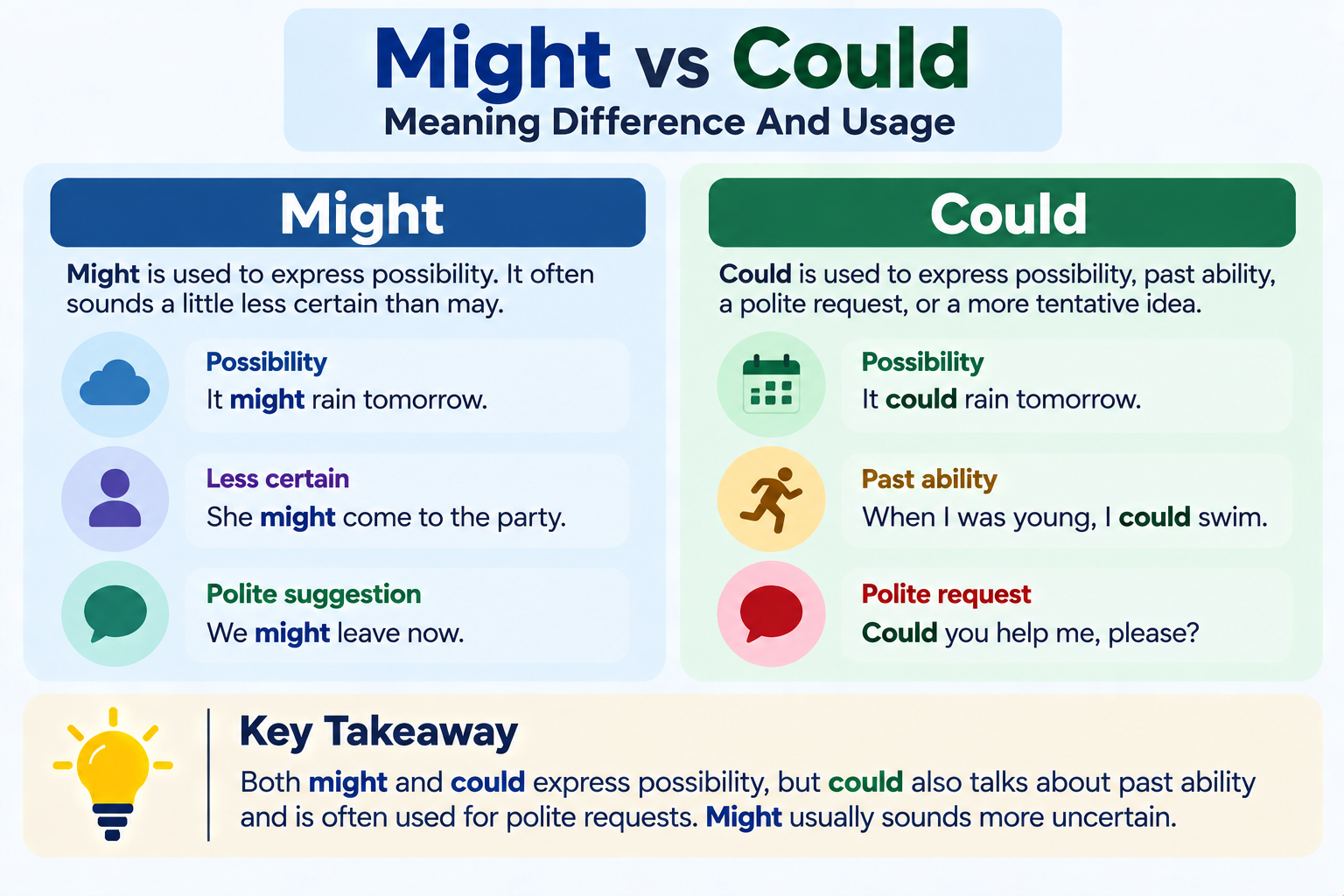
Choosing between might and could can be confusing because both words often describe something that is possible. You might say, “It might rain tomorrow,” or “It could rain tomorrow.” Both sentences sound natural, but do they mean exactly the same thing? Not quite.
The main difference comes down to the kind of possibility you want to express. Might often presents something as a possibility without making a strong claim. Could can describe possibility too, but it also refers to past ability, present ability in certain situations, permission, and polite requests.
Understanding these differences helps you speak more naturally, write clearer sentences, and avoid common grammar mistakes. The right choice depends on your meaning, the situation, and the words around the verb. This guide explains how both forms work, how their meanings overlap, and how to choose the right one in everyday conversations, professional messages, school assignments, and formal writing.
Still confused? Compare Focussing or Focusing Which Spelling Is Correct 2026.
Quick Answer
Both might and could are correct modal verbs, but they have different uses. Might usually expresses possibility or uncertainty, while could can express possibility, ability, permission, or a polite request. They sometimes communicate the same general idea, but they are not interchangeable in every sentence.
Comparison Table
| Feature | Might | Could |
|---|---|---|
| Main meaning | Possibility or uncertainty | Possibility, ability, or permission |
| Part of speech | Modal auxiliary verb | Modal auxiliary verb |
| Present possibility | Yes | Yes |
| Past ability | Not normally | Yes |
| Polite requests | Less common | Very common |
| Permission | Rare in modern everyday use | Common in polite questions |
| Future possibility | Yes | Yes |
| Negative form | Might not | Could not or couldn’t |
| Pronunciation | /maɪt/ | /kʊd/ |
| Formality | Neutral to formal | Neutral to formal |
| Common context | Uncertain situations | Options, abilities, requests, and possibilities |
| Example | She might arrive late. | She could arrive late. |
Meaning and Definition
What Does Might Mean?
Might is a modal auxiliary verb that expresses possibility, uncertainty, or a tentative suggestion. It tells the reader or listener that something is possible, but the speaker does not present it as certain.
For example:
- We might visit Chicago next summer.
- The meeting might finish early.
- He might know the answer.
In each sentence, the speaker considers an event or situation possible. However, the sentence does not confirm that it will happen.
This verb can also make a suggestion sound gentle or less direct.
For example:
- You might try restarting your computer.
- We might want to leave a little earlier.
These sentences offer advice without sounding forceful. The speaker presents an idea rather than giving a direct instruction.
What Does Could Mean?
Could is also a modal auxiliary verb. It has several meanings, depending on the sentence and context. It can express possibility, past ability, potential action, permission, or a polite request.
Consider these examples:
- We could go to the beach tomorrow.
- She could read before she started school.
- Could you help me with this box?
- It could be a simple mistake.
The first sentence describes a possible plan. The second describes an ability in the past. The third is a polite request, and the fourth presents a possible explanation.
The meaning depends on the grammatical pattern and the situation. This makes the word more flexible than a simple expression of uncertainty.
Are Both Words Real English Words?
Yes. Both are established English modal verbs. Neither is a misspelling, informal variation, or incorrect form of the other.
The difference is semantic and grammatical rather than a matter of spelling. Both appear in standard American and British English, and both are appropriate in everyday speech and formal writing.
Key Differences Explained
1. Possibility and Uncertainty
Both verbs can describe something that may happen. However, they can create slightly different impressions.
Might often emphasizes uncertainty. It presents an event as one possible outcome without suggesting that the speaker has a clear reason to expect it.
Example:
– I might attend the conference.
This means attending is possible, but the speaker has not made a decision or commitment.
Could often presents an event as one possible outcome among several.
Example:
– I could attend the conference.
This may suggest that attending is an available option. The speaker may have the time, ability, or opportunity to go.
The distinction is subtle. In many situations, both sentences are correct, and the surrounding context determines the intended meaning.
2. Ability
Could can describe an ability that existed in the past.
Example:
– When I was younger, I could run five miles without stopping.
Here, the word describes a past ability.
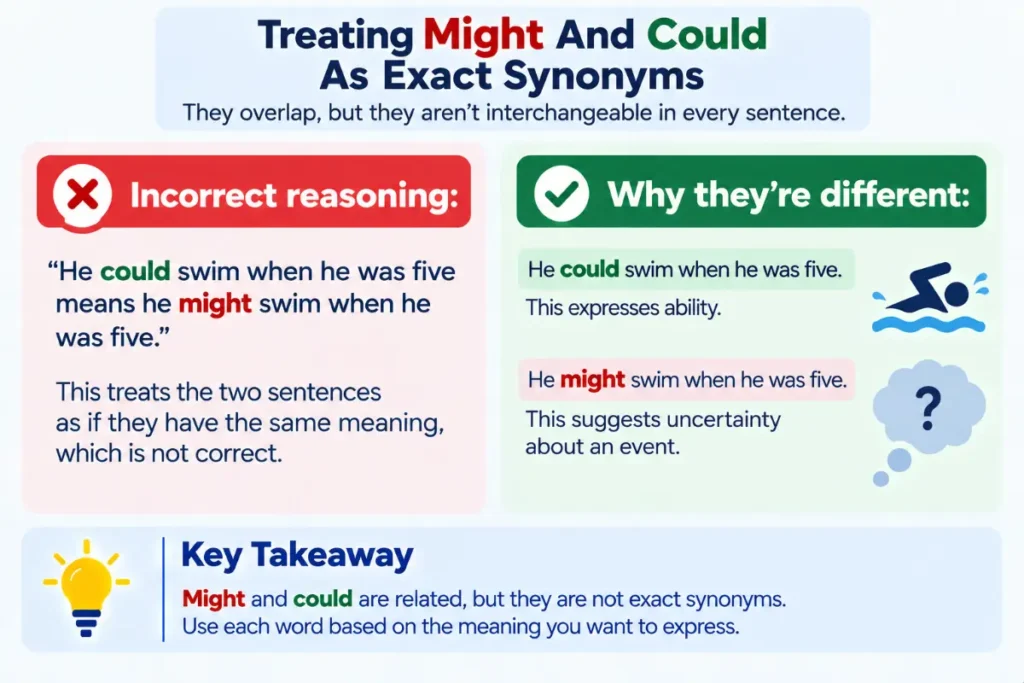
Might does not normally express ability. It describes possibility or uncertainty instead.
Incorrect:
– When I was younger, I might run five miles without stopping.
This sentence does not naturally express the speaker’s past physical ability. A better choice is could.
For a specific successful action in the past, English often uses was able to rather than could.
Example:
– After several attempts, she was able to open the locked door.
This distinction matters because could often describes general past ability, while was able to can emphasize success in a particular situation.
3. Permission
Could is commonly used to ask for permission politely.
Examples:
- Could I borrow your notebook?
- Could we leave a little early?
These questions sound respectful and less direct than commands or statements.
Might can also appear in permission questions, but it often sounds more formal, old-fashioned, or less natural in everyday American conversation.
Example:
– Might I ask you a question?
This is grammatically correct, but it can sound unusually formal in casual settings.
4. Polite Requests
Could is especially useful when asking someone to do something.
Example:
– Could you send me the updated report?
This is a polite request. It does not ask about someone’s theoretical ability. Instead, it asks for help in a considerate way.
Might does not normally serve the same function.
Less natural:
– Might you send me the updated report?
Although this construction is possible in certain formal or old-fashioned styles, most American speakers would choose could or would.
5. Suggestions and Options
Both words can introduce suggestions, but their tone may differ.
Example with might:
– You might want to speak with your manager.
This sounds like gentle advice.
Example with could:
– You could speak with your manager.
This presents one possible action or solution.
The first sentence can sound more tentative. The second highlights an available option.
6. Formality and Tone
Both forms work in formal and informal English. Neither is automatically more professional than the other.
Might can make a statement sound cautious, careful, or diplomatic. Could can make a request sound polite or present a solution without demanding action.
In workplace writing, choose the form that matches your purpose rather than trying to make every sentence sound formal.
Which Word Is Correct?
Both are correct. The right choice depends on the meaning you want to communicate.
Use might when you want to express uncertainty or a possible event. Use could when you want to describe an available option, past ability, permission, or a polite request.
Compare these examples:
- She might join us later. This expresses uncertainty about her plans.
- She could join us later. This may suggest that joining is an available option.
- He might be at home. This presents being at home as a possibility.
- He could be at home. This offers being at home as one possible explanation.
- Could you open the window? This makes a polite request.
A useful editing rule is to identify the job of the modal verb before choosing it. Are you describing uncertainty, ability, an option, or a request? That question usually makes the correct choice clear.
Sentence Examples
The following examples show how both verbs work in different situations.
Examples Using Might
- Everyday conversation: I might stop by the grocery store after work.
- Text message: I might be a few minutes late, so please start without me.
- Workplace communication: The manager might approve your request by Friday.
- School: Our teacher might give us a short quiz tomorrow.
- Academic writing: These findings might suggest a connection between sleep and memory.
- Formal writing: The proposed changes might improve the overall efficiency of the process.
- Social situations: They might invite us to dinner this weekend.
- Online communication: That update might fix the problem with your account.
- Travel: We might take the train instead of driving.
- Daily planning: I might cook dinner at home tonight.
Examples Using Could
- Everyday conversation: We could watch a movie after dinner.
- Text message: Could you call me when you get home?
- Workplace communication: We could schedule the meeting for Thursday.
- School: Students could use the library to complete their research.
- Academic writing: This method could help explain the observed results.
- Formal writing: The organization could consider a different approach.
- Social situations: Could I sit next to you?
- Online communication: You could change your password to improve account security.
- Travel: We could visit the museum before lunch.
- Daily planning: I could pick up the groceries on my way home.
Common Mistakes and Grammar Confusion
Even fluent English speakers sometimes use these modal verbs in ways that do not express their intended meaning. Most problems involve confusing possibility with ability, using the wrong verb pattern, or adding an unnecessary verb ending.
1. Using Might to Describe Past Ability
Incorrect:
– She might speak three languages when she was a child.
Correct:
– She could speak three languages when she was a child.
Why it happens: Both forms can describe uncertain or possible situations, but might does not normally describe an established ability. Use could for a general ability in the past.
2. Adding To After a Modal Verb
Incorrect:
- I might to visit my parents tomorrow.
- We could to finish the work today.
Correct:
- I might visit my parents tomorrow.
- We could finish the work today.
Why it happens: Some English verbs require to before another verb, but modal auxiliary verbs do not follow that pattern. Use the base form of the main verb directly after either modal.
3. Adding an S to the Main Verb
Incorrect:
- He might goes to school tomorrow.
- She could helps us with the project.
Correct:
- He might go to school tomorrow.
- She could help us with the project.
Why it happens: In ordinary present tense sentences, third person singular verbs often take an s. Modal verbs do not follow this rule. The main verb stays in its base form.
4. Confusing Could With Might in a Request
Less natural:
– Might you send me the file?
More natural:
– Could you send me the file?
Why it happens: Might can express possibility, but it is not the usual choice for a polite request in modern American English. Could is the more natural option for asking someone to do something.
5. Using Could Instead of Could Have
Incorrect:
– She could finished the project yesterday.
Correct:
– She could have finished the project yesterday.
Why it happens: When discussing an unrealized or possible past action, could often needs have followed by a past participle.
Example:
– I could have helped you if I had known.
The phrase describes something that was possible in the past but did not happen or was not confirmed.
Need another quick comparison? Read emersion vs immersion: Correct Meaning and Usage.
Pronunciation Guide
These two modal verbs have short, distinct pronunciations.
| Word | IPA | Syllables | Easy pronunciation |
|---|---|---|---|
| Might | /maɪt/ | One | Myt |
| Could | /kʊd/ | One | Kud |
How to Pronounce Might
The word might sounds like myt. Its vowel is the same sound found in words such as light, night, and right.
The pronunciation has one syllable, with the main stress naturally falling on that syllable. The final t is pronounced clearly, although it may sound less noticeable in fast conversation.
How to Pronounce Could
Could sounds like kud. Its vowel is similar to the sound in good, book, and foot in many American accents.
The letter l is silent. Do not pronounce it as kold or koold. The word has one syllable and ends with a d sound.
Common Pronunciation Mistakes
- Pronouncing the l in could.
- Giving might a short i sound instead of the long vowel in my.
- Adding an extra syllable to either word.
- Confusing the vowel in could with the vowel in cold.
Practicing the words in complete sentences can help you hear the difference more clearly.
Etymology and Word Origin
The histories of these words help explain how they developed into their modern grammatical roles.
Origin of Might
Might comes from Old English miht, which was related to the idea of strength, power, or ability. It developed from an earlier Germanic word connected with physical or personal power.
Over time, the form became associated with the past tense of may. Modern English uses it mainly as a modal verb that expresses possibility, uncertainty, or a tentative suggestion.
Although its historical connection involved power and ability, its common modern use is quite different.
Origin of Could
Could developed from the Old English verb cunnan, which meant to know or be able to do something. The form could emerged through historical changes in English spelling and pronunciation.
It became the past form of can and developed several uses. Today, it can describe past ability, possible actions, polite requests, and hypothetical situations.
The word’s history helps explain why it can refer to both ability and possibility in modern English.
Regional Usage
There is no major spelling difference between American, British, Australian, or Canadian English for these words. Both are standard in all four varieties.
American English
In the United States, both forms are widely used in conversation, education, journalism, and professional writing.
Might commonly expresses uncertainty:
– I might call you tonight.
Could commonly expresses ability or a possible option:
– We could take another route.
American speakers also use could frequently in polite requests.
British English
British English follows the same basic grammar rules. Both words express possibility, while could also describes past ability and polite requests.
British speakers may use certain modal expressions differently in specific social settings, but the central distinction remains the same.
Australian English
Australian English uses both forms in the same general way as other standard English varieties. Could is common in polite requests and suggestions, while might often expresses uncertainty.
There is no special Australian spelling rule that changes their use.
Canadian English
Canadian English also follows the same standard grammatical patterns. Both words appear in everyday conversation and formal writing.
Differences in individual expressions may occur, but they do not create a different core meaning for either verb.
Grammar Rules and Part of Speech
Both words belong to a group called modal auxiliary verbs. These verbs work with a main verb to express ideas such as possibility, ability, permission, and intention.
They do not usually function as the main action verb by themselves.
1. Use the Base Form of the Main Verb
A modal verb is followed by the base form of another verb.
Correct:
- She might come tomorrow.
- He could finish the task.
- They might agree with us.
- We could leave early.
Incorrect:
- She might comes tomorrow.
- He could finished the task.
- They might to agree with us.
The main verb does not take an s, ed, or ing ending directly after the modal.
2. Form Negative Sentences
To make a sentence negative, place not after the modal verb.
Examples:
- I might not attend the event.
- She could not find her keys.
- They might not understand the instructions.
- We couldn’t complete the project on time.
Might not usually expresses the possibility that something will not happen. Could not can express inability, impossibility, or a negative possibility, depending on context.
For example:
– He might not come tonight.
This means his arrival is uncertain.
– He couldn’t come last night.
This can mean he was unable to attend.
3. Form Questions
Place the modal verb before the subject when forming a direct question.
Examples:
- Might she need more time?
- Could you explain this rule?
- Could they arrive before noon?
Questions with could are especially common in polite requests. Questions with might are possible, but they can sound more formal.
4. Use Them in Conditional Sentences
Both forms appear in conditional sentences.
Examples:
- If we leave now, we might reach the station on time.
- If you practiced more, you could improve your speaking skills.
- If it rains tomorrow, we might cancel the picnic.
- If I had more time, I could learn another language.
In these examples, the modal verbs express possible results or hypothetical situations.
5. Use Them With Have for Past Possibilities
Both words can combine with have and a past participle to discuss past events.
Examples:
- She might have missed the train.
- He could have forgotten the appointment.
- They might have taken the wrong road.
- We could have finished earlier.
Might have often suggests uncertainty about what happened. Could have can express a possible past event or an opportunity that was not used.
Compare:
– She might have called you.
The speaker is unsure if the call happened.
– She could have called you.
The call was possible, but the sentence may suggest that she did not make it.
Context determines the exact meaning.
6. Use Them in Formal and Informal Writing
Both words are acceptable in formal writing, but their purpose matters.
In an academic paper, might can help express a careful interpretation:
– The results might indicate a change in consumer behavior.
Could can describe a possible explanation or practical implication:
– The proposed method could improve the reliability of future tests.
In casual conversation, both words sound natural:
- I might stay home tonight.
- We could order pizza.
Neither requires special punctuation. Follow ordinary sentence punctuation rules.
Real Life Usage Examples
The same modal verb can serve different purposes across everyday life. These examples show how context affects the meaning.
Daily Conversation
People often use might when they are unsure about plans or future events.
- I might go shopping after lunch.
- He might be waiting outside.
Could often appears when discussing available choices.
- We could eat at the new restaurant.
- You could take the bus if you don’t want to drive.
Email and Workplace Communication
In professional messages, might helps make statements cautious and diplomatic.
- The client might request another revision.
- We might need additional time to complete the report.
Could helps suggest actions or ask for assistance politely.
- Could you review the attached document?
- We could arrange a short meeting next week.
Academic Writing
Academic writers use might to avoid presenting uncertain interpretations as established facts.
- The results might reflect changes in the study environment.
- This pattern might suggest a link between the two variables.
Could is useful when discussing potential explanations or applications.
- The findings could support further research.
- This approach could offer a useful framework for future studies.
News and Journalism
News reports often use might when an outcome remains uncertain.
- Officials said the new policy might affect local businesses.
- The storm might bring heavy rain to coastal areas.
Could can introduce possible consequences or developments.
- The proposed law could change how companies report their earnings.
- Higher fuel costs could affect transportation prices.
Literature and Storytelling
Writers use might to build suspense or suggest an uncertain future.
- She wondered if the old house might hold another secret.
- He knew the journey might change his life.
Could often describes an available action or a possible outcome.
- One wrong step could send him tumbling down the hill.
- She could hear footsteps approaching from the hallway.
Related and Confused Terms
Several other English words express ideas that overlap with these modal verbs. Learning their differences can make your writing more precise.
1. May
May expresses possibility or permission.
Example:
– It may rain this afternoon.
May and might often have similar meanings. In some contexts, may sounds slightly more direct, while might sounds more tentative. However, this is not a strict rule.
2. Can
Can commonly expresses present ability, general possibility, or informal permission.
Example:
- She can speak French.
- Can I use your phone?
Unlike could, can usually refers to present ability rather than general past ability.
3. Would
Would often expresses hypothetical situations, polite requests, or repeated past actions.
Example:
- I would travel more if I had extra money.
- Would you close the door?
It differs from might because it often describes an imagined action or result rather than simple uncertainty.
4. Should
Should expresses advice, expectation, or duty.
Example:
- You should get more sleep.
- The package should arrive tomorrow.
Might presents a possibility, while should often suggests what is advisable or expected.
5. Must
Must expresses strong obligation or a strong logical conclusion.
Example:
- You must wear a seat belt.
- She must be tired after such a long trip.
It usually communicates greater force or confidence than might.
6. May Have
May have describes a possible past event.
Example:
– They may have forgotten the meeting.
It is similar to might have, although the speaker’s tone and degree of uncertainty can vary with context.
7. Could Have
Could have describes a past possibility, an unused opportunity, or something that was possible but did not happen.
Example:
– I could have joined the team, but I chose another job.
It can also suggest an uncertain explanation:
– He could have taken the wrong train.
8. Might Have
Might have usually expresses uncertainty about a past event.
Example:
– She might have left her wallet at the office.
The speaker does not know for sure if this happened. The phrase presents it as one possible explanation.
Expert Editor Insight
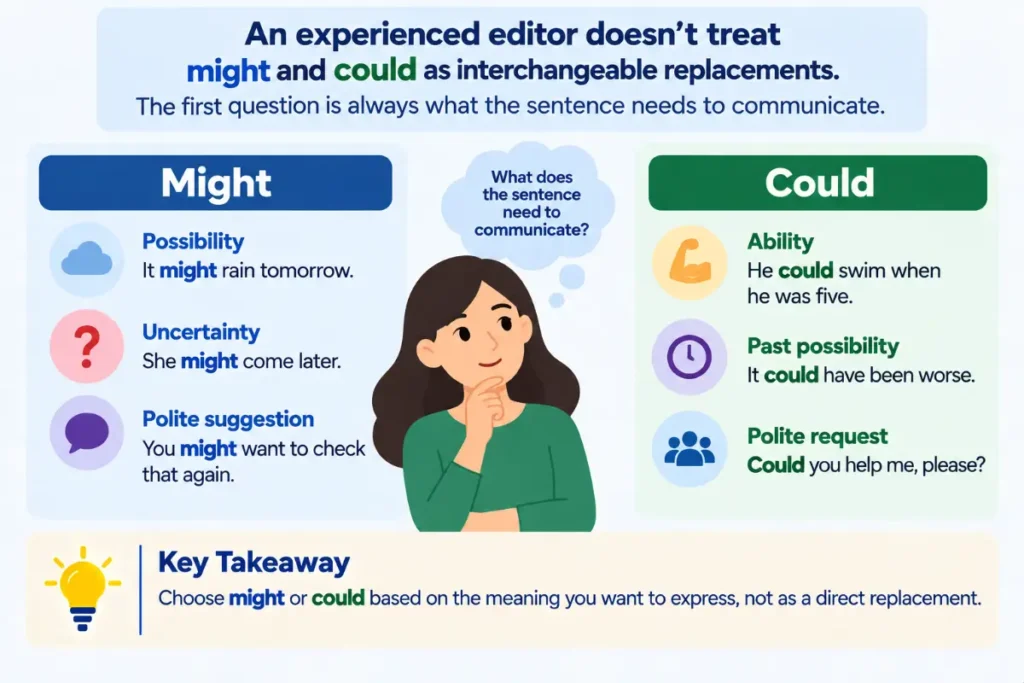
Experienced English editors look at the meaning of a sentence before changing a modal verb. They do not replace one with the other simply because both express possibility. If the sentence describes uncertainty, might may be the better choice. If it describes past ability, a possible action, or a polite request, could may fit better. Grammar tools can identify some incorrect verb patterns, such as adding to after a modal, but they may not understand subtle differences in tone. A useful editing tip is to ask what the speaker wants the reader to understand before making a change.
For another common grammar confusion, see Inclosed vs Enclosed Which Spelling Is Correct..
Conclusion
The difference between might vs could depends on the meaning you want to express. Both are correct modal verbs, and both can describe possibility. However, might usually communicates uncertainty, while could also expresses past ability, available options, permission, and polite requests. Neither word is always more formal or more accurate than the other.
Choose the one that fits your sentence. A simple editing trick is to identify the purpose first: uncertainty often calls for might, while ability or a polite request often calls for could. This small check can make your English clearer and more natural.
FAQs
Is Might More Uncertain Than Could?
Might often sounds more tentative because it presents something as a possibility without suggesting a clear opportunity or ability. Could can also express uncertainty, but it may describe an available option or possible explanation. The difference is not a fixed measure of probability. Context, tone, and the rest of the sentence help communicate the speaker’s meaning.
Can I Use Might and Could in the Same Sentence?
Yes, both can appear in one sentence when they serve different purposes. For example, “We might choose the route that could save us an hour.” The first modal expresses uncertainty about the decision, while the second describes a possible benefit. Each word has its own grammatical role and meaning.
Is Could the Past Tense of Can?
Yes. Could is commonly used as the past form of can when describing general ability. For example, “When she was young, she could swim very well.” However, could also has present and future uses, such as polite requests and possible actions. Its meaning depends on the sentence rather than tense alone.
Does Might Mean the Same as May?
May and might both express possibility, and they can often replace each other without changing the main idea. However, might can sound more tentative in some situations. May also has a common use for permission, as in “You may leave now.” The best choice depends on the intended meaning and tone.
Can Could Be Used for Future Possibility?
Yes. Could can describe something that is possible in the future. For example, “We could visit the park tomorrow” presents a possible plan. It does not guarantee that the visit will happen. The sentence may also suggest that visiting the park is one option among several available choices.
Is Might Appropriate in Formal Writing?
Yes. Might is common in formal writing, especially when discussing uncertain outcomes, possible explanations, or careful conclusions. Academic writers often use it to avoid making claims that go beyond the available evidence. For example, “The findings might indicate a change in behavior” communicates caution without making the sentence unclear.
How Do I Ask for Something Politely?
Could is one of the most natural choices for polite requests in modern English. For example, “Could you send me the report?” sounds respectful and clear. Might is less common for this purpose and can sound overly formal. You can also use would, as in “Would you mind sending me the report?”
Can Might and Could Be Used With Have?
Yes. Both forms can be followed by have and a past participle. Might have usually expresses uncertainty about a past event, as in “She might have missed the bus.” Could have can describe a possible past event or an unused opportunity, as in “We could have won the game.”