
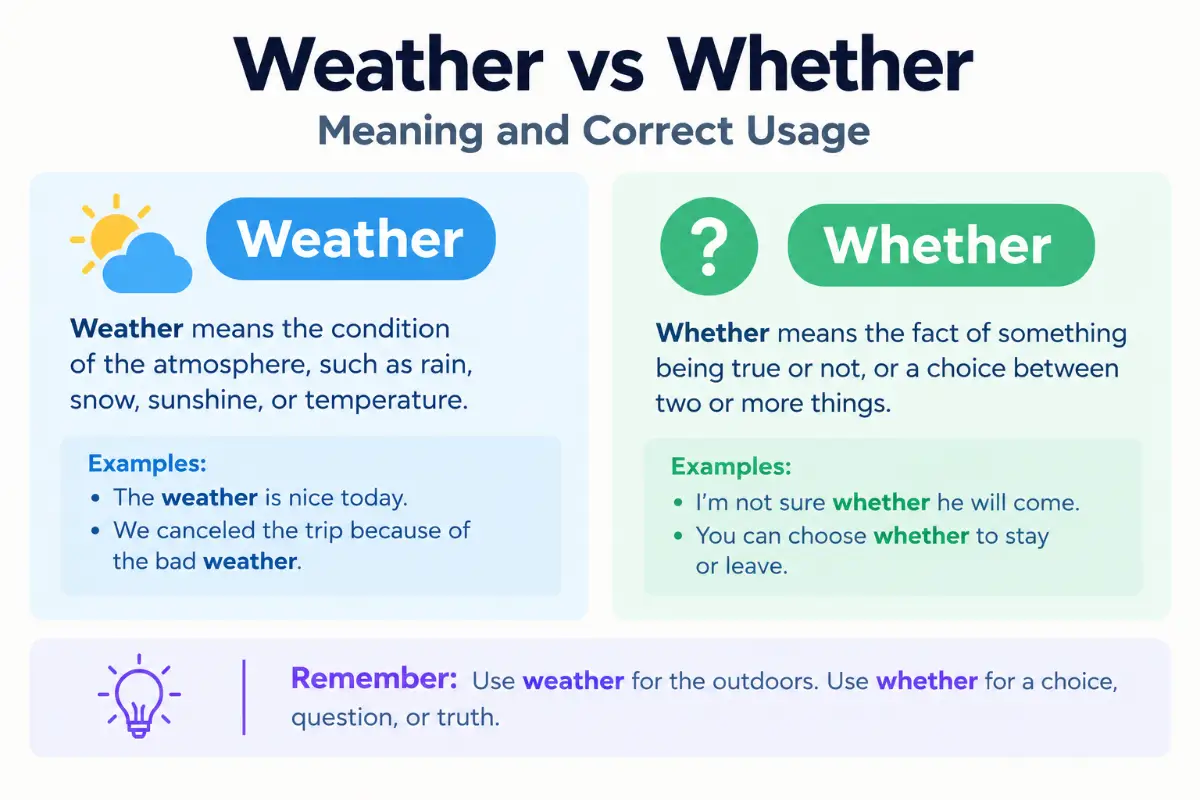
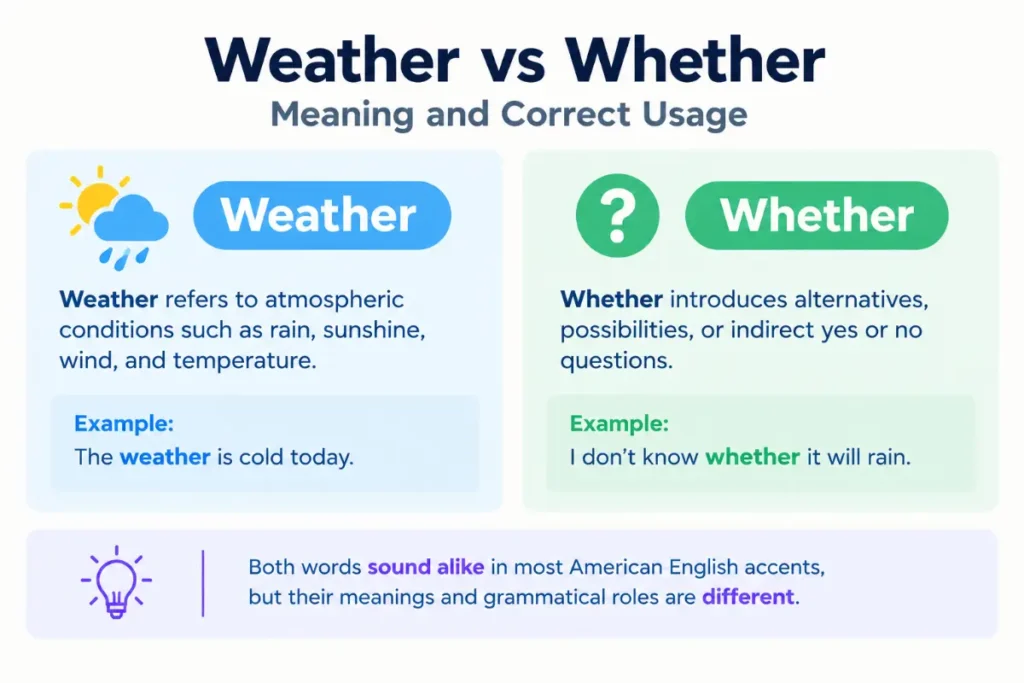
Have you ever stopped while writing because you could not decide between “weather” and “whether”? You are not alone. Both words are spelled correctly, both are common in English, and they sound exactly alike in most accents. However, they have completely different meanings and grammatical jobs. Weather refers to conditions in the atmosphere, such as rain, sunshine, wind, and temperature. Whether introduces a choice, possibility, or indirect question.
The confusion happens because English has many words that share a pronunciation but use different spellings and meanings. These words are called homophones. A spell checker may accept either one, even when you have chosen the wrong word for your sentence. That makes understanding the context especially important.
The easiest way to choose correctly is to connect each word with its purpose. One describes the conditions outside. The other helps express uncertainty or alternatives. Once you understand their meanings, common sentence patterns, and examples, you can use both confidently in emails, school assignments, work documents, and everyday conversations.
Learn the difference in Gradual Vs Insidious Which Word Should You Use in 2026.
Quick Answer
Weather is a noun that describes the condition of the atmosphere, including rain, snow, sunshine, wind, and temperature. Whether is a conjunction that introduces alternatives or expresses uncertainty, as in “I don’t know whether she will come.” Both are correct words, but they cannot be used interchangeably.
Comparison Table
| Feature | Weather | Whether |
|---|---|---|
| Correct spelling | Weather | Whether |
| Main meaning | Conditions in the atmosphere | Expresses alternatives or uncertainty |
| Part of speech | Mainly a noun; also a verb | Subordinating conjunction |
| Pronunciation | /ˈwɛðər/ | /ˈwɛðər/ |
| Syllables | Two | Two |
| Common use | Weather forecast, rainy weather, cold weather | Whether to go, whether it works, whether or not |
| Grammar function | Names atmospheric conditions or describes their effect | Introduces an indirect question or alternative |
| Formality | Standard in all forms of English | Standard in all forms of English |
| Example | The weather is sunny today. | I wonder whether it will rain. |
Meaning and Definition
What Does Weather Mean?
Weather refers to the condition of the atmosphere at a particular place and time. It includes elements such as temperature, wind, humidity, cloud cover, rain, snow, and storms. It can change throughout the day, so a morning that starts sunny may become cloudy or rainy by the afternoon.
The word is most often used as a noun. It appears in everyday conversations, weather reports, travel plans, news stories, and scientific discussions about the atmosphere.
For example:
- The weather is warm and sunny today.
- We stayed home because of the bad weather.
- The weather forecast predicts heavy rain.
- Cold weather can make driving more difficult.
- The mountain weather changes quickly.
In each sentence, the word refers to atmospheric conditions. It does not introduce a choice or express doubt.
The term also appears in common expressions such as “weather forecast,” “weather conditions,” “weather report,” and “weather warning.” These phrases describe information about the atmosphere or its effects.
Can Weather Be a Verb?
Yes. Although people use it mainly as a noun, it can also function as a verb. As a verb, it means to withstand or survive something difficult, or to change due to exposure to the elements.
For example:
- The old wooden fence has weathered many storms.
- The company managed to weather the financial crisis.
- Wind and rain slowly weathered the stone surface.
In these examples, the word does not describe today’s forecast. It describes enduring hardship or the gradual effects of exposure.
The verb also has related forms:
| Form | Example |
|---|---|
| Weather | The building must weather the storm. |
| Weathers | She weathers difficult situations well. |
| Weathered | The roof weathered the heavy rain. |
| Weathering | The rocks are weathering over time. |
This verb meaning is useful to know because it shows that the word has a wider role than simply naming sunshine or rain.
What Does Whether Mean?
Whether is a conjunction used to introduce alternatives, express uncertainty, or report an indirect question. It helps connect a statement to two or more possible outcomes.
For example:
- I don’t know whether he is coming.
- She asked whether the office was open.
- We need to decide whether to stay or leave.
- Tell me whether you agree.
- They haven’t decided whether the plan will work.
In these sentences, the word does not describe the atmosphere. It introduces something that is unknown, questioned, or being considered.
It commonly appears after verbs such as:
- Know.
- Ask.
- Wonder.
- Decide.
- Determine.
- Check.
- Find out.
- Consider.
For example, “I wonder whether the train is late” expresses uncertainty. The speaker does not know the answer and is thinking about a possibility.
What Does Whether or Not Mean?
The expression “whether or not” emphasizes that a situation has two possible outcomes. It can mean that something will happen regardless of the result, or it can introduce a choice between alternatives.
Consider these examples:
- We will go whether or not it rains.
- She must decide whether or not to accept the offer.
- I’ll support you whether or not others agree.
In the first sentence, the decision to go does not depend on the rain. In the second, the person is considering two options: accepting the offer or declining it. In the third, support remains the same regardless of other people’s opinions.
The word “or” is not always necessary. You can write “I don’t know whether she will attend” or “I don’t know whether or not she will attend.” Both are grammatically correct, although the shorter version is often more direct.
Key Differences Explained
1. Meaning
The biggest difference is what each word communicates.
Weather describes the atmosphere. It answers questions such as:
- Is it raining?
- Is the temperature high?
- Is the sky cloudy?
- Is there a strong wind?
Whether introduces a question, possibility, or choice. It answers a different kind of question:
- Is she coming or staying home?
- Should we leave or wait?
- Is the information correct or incorrect?
Compare these sentences:
- The weather looks cloudy.
- I don’t know whether it will rain.
The first describes the sky. The second expresses uncertainty about a possible event.
2. Part of Speech
Weather mainly functions as a noun. It can also work as a verb when describing the act of withstanding or being changed by exposure.
Whether is a subordinating conjunction. It connects a dependent clause to a main clause and introduces an indirect question or alternatives.
This difference matters because the words occupy different positions in a sentence. You can say “The weather is pleasant,” but you cannot use whether in that sentence to name atmospheric conditions.
3. Grammar
The noun usually appears with descriptive words and verbs:
- Pleasant weather.
- Stormy weather.
- The weather changed.
- The weather is improving.
The conjunction usually appears after a verb or expression that introduces uncertainty or choice:
- I wonder whether…
- She asked whether…
- We must decide whether…
- It is unclear whether…
These patterns provide a useful clue. If the sentence needs the name of atmospheric conditions, use the noun. If it needs to introduce a possible answer or choice, use the conjunction.
4. Pronunciation
Both words are homophones in standard American English. This means they have the same pronunciation despite having different spellings and meanings.
Their usual IPA pronunciation is /ˈwɛðər/. The first syllable receives the main stress, and the middle consonant is the voiced th sound found in “this” and “that.”
Because they sound alike, listening alone may not help you choose the correct spelling. You need to understand the sentence.
5. Formality
Both words are standard and appropriate in formal and informal English. There is no reason to avoid either one in professional writing, academic assignments, or everyday communication.
The difference is not about tone. It is about meaning and grammar. Using the wrong word can make a sentence confusing, even if the spelling itself is valid.
6. Context
Context is the most reliable way to distinguish the two. Look at the words around the blank and decide what the sentence needs.
For example:
– We checked the ______ before planning the picnic.
The sentence needs a noun that refers to outdoor conditions, so “weather” is correct.
– We checked ______ the picnic would be canceled.
The sentence introduces an indirect question, so “whether” is correct.
The surrounding words make the choice clear.
7. Regional Usage
The distinction remains the same in American, British, Canadian, and Australian English. Both words have the same standard spellings and basic meanings across these varieties.
Some regional accents may pronounce the words slightly differently, but the difference between their meanings does not change. Writers in all these regions should choose the spelling based on the intended meaning.
8. Standard Versus Incorrect Usage
Neither word is incorrect on its own. The mistake happens when a writer uses one in place of the other.
For example, “The whether is beautiful” is incorrect because the sentence needs a noun describing atmospheric conditions. The correct sentence is “The weather is beautiful.”
Similarly, “I don’t know weather she is ready” is incorrect in standard writing. The correct form is “I don’t know whether she is ready.”
Both spellings are real words. The sentence determines which one belongs.
Which Spelling Is Correct?
Both spellings are correct English words. The right choice depends on the meaning of the sentence, not on a spelling rule that makes one form better than the other.
Use weather when you mean the atmosphere or the conditions outside. Use whether when you introduce an indirect question, express uncertainty, or present alternatives.
A useful way to check your choice is to replace the word with a short explanation:
- If you can replace it with “rain, sunshine, wind, or temperature,” choose “weather.”
- If you can replace it with “if” in an indirect question, choose “whether” in most cases.
- If the sentence presents two possible actions or outcomes, the conjunction is usually the correct choice.
For example, “We don’t know whether the flight will be delayed” can become “We don’t know if the flight will be delayed.” The meaning stays nearly the same. However, “The weather will be cold tomorrow” cannot use “if” in place of the noun.
Standard dictionaries recognize both forms as separate entries with different meanings and grammatical functions. A spelling checker may accept both, so you should always review the sentence rather than relying only on automatic corrections.
Ten Natural Sentence Examples
These examples show how each word works in everyday situations, school, professional communication, and formal writing.
Examples Using Weather
- Everyday conversation: The weather is perfect for a walk in the park.
- Text message: The weather looks bad, so let’s meet indoors instead.
- Work: Please check the weather forecast before scheduling the outdoor event.
- School: Our science teacher explained how weather patterns affect the environment.
- Academic writing: Changes in temperature and rainfall can influence local weather conditions.
- Formal writing: Severe weather may cause delays to public transportation.
- Travel: We packed warm clothes because the mountain weather can change quickly.
- News: Local officials issued a warning about dangerous weather conditions.
- Social situations: Everyone enjoyed the picnic because the weather stayed pleasant.
- Figurative use: The small business managed to weather a difficult year.
The final example uses the verb form. It means the business survived a challenging period, not that it experienced a particular type of atmospheric condition.
Examples Using Whether
- Everyday conversation: I don’t know whether Sam is coming tonight.
- Text message: Let me know whether you want pizza or pasta.
- Work: Please confirm whether the client approved the revised schedule.
- School: The teacher asked whether everyone had completed the assignment.
- Academic writing: The research examines whether regular exercise improves sleep quality.
- Formal writing: The committee will determine whether the application meets the requirements.
- Travel: We need to decide whether to book the earlier flight.
- News: Officials have not confirmed whether the road will reopen today.
- Social situations: She wondered whether her friends would enjoy the surprise.
- Online communication: Check whether your account settings allow notifications.
In each example, the conjunction introduces an unknown answer, an indirect question, or a choice. It does not describe the weather outside.
Common Mistakes and Misspellings
These two words create a special problem for writers because they sound alike. The spelling error often goes unnoticed during proofreading, especially when a person relies on pronunciation instead of meaning.
1. Using Whether to Describe Outdoor Conditions
Incorrect: The whether is sunny today.
Correct: The weather is sunny today.
The sentence needs a noun that describes the atmosphere. The conjunction cannot fill that role. A simple check is to ask if the sentence describes rain, sunshine, temperature, or wind. If it does, use the noun.
2. Using Weather to Introduce an Indirect Question
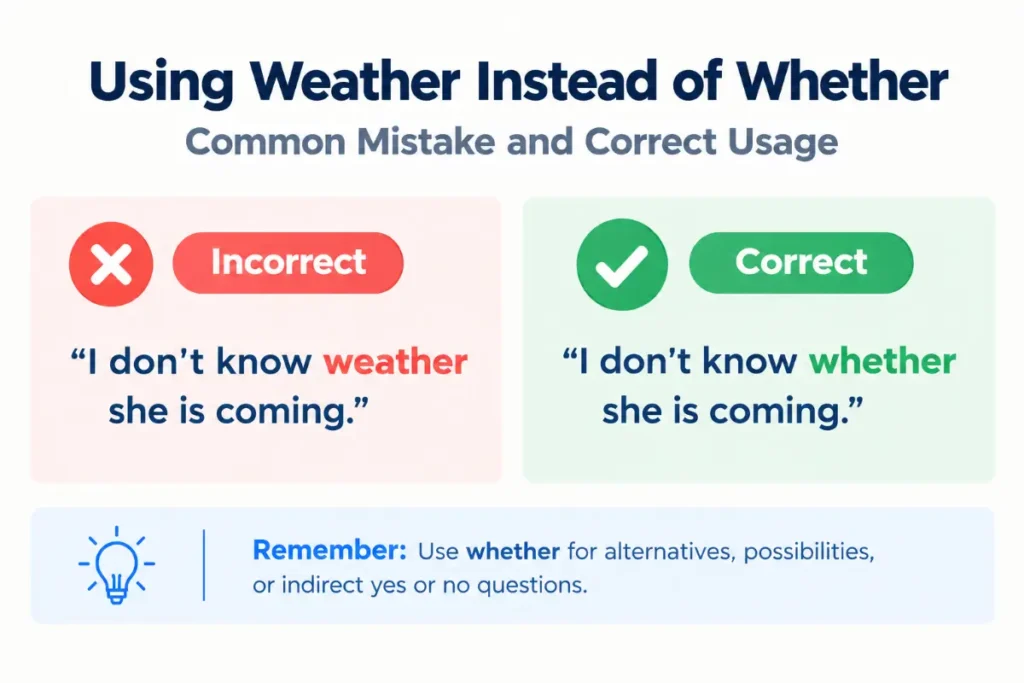
Incorrect: I don’t know weather he received my email.
Correct: I don’t know whether he received my email.
The sentence introduces an unknown answer. The conjunction connects the main statement to the indirect question. The atmospheric noun has no grammatical role in this structure.
3. Confusing Whether With a Direct Question
Incorrect: She asked whether did I finish the report.
Correct: She asked whether I finished the report.
An indirect question normally uses statement word order. Do not add the question form “did I” after the conjunction in this sentence. The direct version would be “Did I finish the report?” The reported version becomes “She asked whether I finished the report.”
4. Adding Or Not When It Is Not Needed
Wordy: I don’t know whether or not we should leave now.
Clearer: I don’t know whether we should leave now.
Both versions are grammatical, but the shorter one is often enough. Use “or not” when you want to stress the two possible outcomes or when the sentence benefits from that emphasis. Do not add it automatically.
5. Forgetting the Difference in Weather Related Expressions
Incorrect: The whether forecast says it will snow.
Correct: The weather forecast says it will snow.
The phrase “weather forecast” is a fixed and familiar expression. It refers to a prediction about atmospheric conditions. Remembering common combinations can help prevent this type of mistake.
Other Typing Errors to Watch For
Writers may also type forms such as “wether” or “wheather.” These are not standard spellings for the two words discussed here. A quick spell checker may catch them, but it may not catch a correctly spelled word used in the wrong place.
The most reliable proofreading method is to read the entire sentence and check its meaning. Do not judge the spelling only by how the word sounds.
Pronunciation Guide
How Do You Pronounce Weather?
In standard American English, the word is pronounced /ˈwɛðər/. It has two syllables:
- WETH.
- UHR.
The stress falls on the first syllable. The first vowel sounds like the vowel in “bed,” and the middle consonant is the voiced th sound heard in “this.”
A simple pronunciation guide is “WETH-er.” Say the first syllable clearly, then finish with a relaxed second syllable.
How Do You Pronounce Whether?
The usual American English pronunciation is also /ˈwɛðər/. It has two syllables, with stress on the first one. The vowel and consonant sounds match those in the other word.
This shared pronunciation is the main reason people confuse the spellings. You cannot reliably identify the intended word by sound alone. The sentence must provide the clue.
What Is the Difference Between Their Sounds?
In most American accents, there is no difference in pronunciation. Both begin with the same /w/ sound, use the same short e vowel, include the voiced th sound, and end with an unstressed syllable.
Some English speakers may have accent based differences in vowel quality or the final syllable. These variations do not create a standard pronunciation distinction between the two spellings.
Common Pronunciation Errors
A common error is to pronounce the middle consonant as an unvoiced th, like the sound in “think.” The usual pronunciation uses the voiced sound in “this.” You can feel the difference by placing your fingers lightly against your throat as you say each word. The voiced sound creates vibration.
Another mistake is to put too much stress on the final syllable. The main stress belongs on the first syllable in standard pronunciation.
Still confused? Compare waring vs wearing Correct Spelling Meaning and Usage.
Etymology and Word Origin
Where Does Weather Come From?
The noun has roots in Old English. It developed from the Old English word “ weder,” which referred to air, sky, or atmospheric conditions. It is also related to words in other Germanic languages that describe the air or conditions around us.
Over time, the meaning became more closely connected with the state of the atmosphere at a particular time and place. Modern English uses the word for everything from a pleasant sunny day to a severe storm.
The verb developed related senses involving exposure to the elements and the ability to withstand difficult conditions. That is why English speakers can say that a building has weathered years of rain or that a family has weathered a difficult period.
Where Does Whether Come From?
The conjunction also has Old English roots. It developed from forms associated with the idea of which of two alternatives is involved. Its history connects it with the use of alternatives and uncertainty in English.
Over time, the word became an established way to introduce indirect questions and choices. Modern expressions such as “whether to stay,” “whether it is true,” and “whether or not” reflect this role.
Why Do Their Spellings Look So Similar?
The two words developed through different historical paths, but their modern forms share several letters. English spelling also preserves distinctions that pronunciation does not always show. As a result, two words can sound alike while keeping different spellings and meanings.
Their similar appearance and identical pronunciation make them easy to mix up. Knowing their word histories can be interesting, but the practical solution is to learn the grammatical role of each one.
Regional Usage
American English
Both spellings are standard in American English. Weather is used for atmospheric conditions, forecasts, and related expressions. Whether introduces alternatives and indirect questions.
In the United States, the two words are generally pronounced alike. This makes them a common source of errors in emails, school assignments, social media posts, and other writing.
Examples:
- The weather should improve by Friday.
- I haven’t decided whether to attend the event.
British English
British English follows the same spelling and meaning distinction. The noun describes atmospheric conditions, while the conjunction introduces alternatives or indirect questions.
The pronunciation is also very similar in most British accents. Some regional accents may change the vowel or final syllable slightly, but they do not change the words’ standard meanings.
Examples:
- The weather has been unusually cold this week.
- She asked whether the train was still running.
Australian English
Australian English uses both forms in the same way. Weather is common in forecasts and everyday discussions about outdoor conditions. Whether appears in questions about decisions, possibilities, and uncertain outcomes.
There is no special Australian spelling rule that changes the distinction.
Examples:
- The weather is expected to remain warm this afternoon.
- We need to find out whether the store is open.
Canadian English
Canadian English also keeps the same spelling and grammar. Both forms are standard, and writers choose between them based on meaning.
Weather is especially common in conversations about seasonal changes, snow, rain, and temperature. Whether works in the same sentence patterns found in American and British English.
Examples:
- The winter weather made the roads difficult to travel.
- The school has not announced whether classes will be canceled.
Across all four varieties, the rule remains simple: one word describes atmospheric conditions, and the other introduces alternatives or uncertainty.
Grammar Rules and Part of Speech
Understanding the grammatical role of each word makes the spelling choice much easier. One is mainly a noun, while the other is a conjunction. Their sentence patterns are different, so learning a few common structures will help you use them accurately.
How to Use Weather as a Noun
The noun can be used as the subject or object of a sentence. It can also appear after a linking verb or as part of a longer phrase.
As a subject:
- The weather is changing.
- The weather looks pleasant.
As an object:
- We enjoyed the warm weather.
- The storm damaged several homes during the severe weather.
After a descriptive adjective:
- The cold weather affected the crops.
- The humid weather made the afternoon uncomfortable.
In most everyday uses, the noun is uncountable. You generally say “the weather,” “bad weather,” or “nice weather,” not “a weather.” You can, however, use countable expressions such as “a spell of bad weather” or “different types of weather.”
How to Use Weather as a Verb
The verb means to withstand, survive, or change due to exposure. It can take a direct object.
Examples:
- The old bridge weathered several major storms.
- The company weathered the economic downturn.
- Sunlight and rain are weathering the paint.
The subject is the person, object, or organization experiencing the effects. The object is the hardship or condition being endured, or the material being changed by exposure.
How to Use Whether as a Conjunction
The conjunction introduces a dependent clause. It often follows a verb that expresses thought, knowledge, inquiry, or decision.
Common patterns include:
- Know whether: I don’t know whether the package arrived.
- Ask whether: She asked whether the room was available.
- Wonder whether: He wondered whether the answer was correct.
- Decide whether: They must decide whether to continue.
- Check whether: Please check whether the door is locked.
- Determine whether: The test will determine whether the system works.
These patterns are useful because the word connects the main statement with an indirect question or possibility.
Whether Before an Infinitive
The conjunction can appear before “to” and a base verb. This structure presents a choice about an action.
Examples:
- I can’t decide whether to travel.
- She is considering whether to accept the offer.
- We discussed whether to change the meeting time.
The person is considering an action rather than asking a direct question. The structure is concise and common in both formal and informal writing.
Whether With Two Alternatives
You can use the conjunction to connect two possible choices.
Examples:
- I can’t decide whether to drive or take the train.
- We need to choose whether to meet today or tomorrow.
- The team must determine whether the problem is technical or procedural.
The alternatives may be actions, descriptions, or complete clauses. Make sure the two parts of the sentence fit together grammatically.
Whether or Not in a Sentence
The phrase can emphasize that both possibilities are being considered.
Examples:
- I will attend whether or not it rains.
- She plans to apply whether or not her friends join her.
- We need to finish the work whether or not the manager is available.
You can often remove “or not” without changing the main point. Keep it when it adds emphasis or makes the alternatives clearer.
Can Whether Start a Sentence?
Yes. It can begin a sentence when the writer is introducing a question or issue for discussion.
For example:
- Whether we leave now depends on the traffic.
- Whether the plan succeeds remains unclear.
- Whether she accepts the offer is her decision.
In these examples, the opening clause acts as the subject of the main sentence. The structure is grammatically correct, although it can sound more formal than a simple sentence that begins with “I don’t know” or “It is unclear.”
Can Weather Start a Sentence?
Yes. The noun can start a sentence when it is the subject.
Examples:
- Weather affects travel plans during the winter.
- Weather conditions can change quickly in the mountains.
- Weather played a major role in the team’s decision.
The word does not need to appear after an article or adjective. It can directly introduce a statement.
Punctuation Rules
Neither word requires special punctuation. Use normal sentence punctuation based on the structure.
A direct question ends with a question mark:
- Will the weather improve tomorrow?
- Do you know whether the office is open?
An indirect question usually ends with a period:
- I wonder whether the office is open.
- She asked whether the weather would improve.
Do not add a question mark simply because an indirect question contains an unknown answer. The sentence’s overall structure determines the punctuation.
Real Life Usage Examples
These examples show how the two words appear in different forms of communication. They also demonstrate how the surrounding sentence helps identify the correct spelling.
Daily Conversation
- The weather is too cold for an outdoor lunch.
- I can’t remember whether I locked the front door.
The first sentence describes the temperature outside. The second expresses uncertainty about an action.
Email and Workplace Communication
- Please review the weather forecast before confirming the outdoor event.
- Let me know whether you have approved the updated proposal.
The first sentence refers to planning around atmospheric conditions. The second asks for confirmation about a decision.
Academic Writing
- Extreme weather can affect crop production and food supplies.
- The researchers examined whether changes in temperature influenced the results.
The first sentence discusses a scientific topic. The second introduces the question that the researchers investigated.
News and Journalism
- Severe weather forced several schools to close on Monday.
- Officials have not confirmed whether the airport will reopen this evening.
News reports use the noun to describe atmospheric events and the conjunction to report uncertain information.
Literature and Storytelling
- The travelers waited inside the cabin until the stormy weather passed.
- She wondered whether the mysterious letter contained the answer.
The first sentence sets the scene. The second reveals a character’s uncertainty and helps build interest.
Related and Confused Terms
These eight terms and expressions are useful because they connect with the meanings or grammar of the two words.
1. Climate
Climate describes the usual weather patterns of a region over a long period. Weather refers to atmospheric conditions at a particular time and place. For example, a region may have a warm climate but experience cold weather on a particular day.
2. Forecast
A forecast is a prediction about future conditions. A weather forecast may predict rain, sunshine, wind, or temperature changes. The term is closely associated with atmospheric reports, but it does not replace the noun itself.
3. Atmosphere
The atmosphere is the layer of gases surrounding Earth. Weather develops through processes in the atmosphere, including changes in temperature, pressure, moisture, and wind. The two terms are related, but they do not mean the same thing.
4. Whether or Not
This expression introduces two possible outcomes or emphasizes that something will happen regardless of the result. For example, “We will continue whether or not the weather improves” uses the conjunction to connect two possibilities.
5. If
“If” can introduce a condition or an indirect question. It often has a similar meaning to the conjunction in sentences such as “I don’t know if she is coming.” However, the two words are not interchangeable in every grammatical structure.
6. Unless
“Unless” means “except if” or “if not.” It introduces a condition that must be met for something to happen. For example, “We will play outside unless it rains” expresses a condition, not an indirect question.
7. Wether
“Wether” is a real but uncommon English noun. It refers to a castrated male sheep. It is not an alternative spelling for atmospheric conditions or a conjunction, so it is rarely relevant in ordinary writing.
8. Weatherproof
“Weatherproof” describes something designed or treated to resist damage from rain, wind, or other outdoor conditions. A weatherproof jacket, for example, offers protection from the elements. It is a compound word built from the atmospheric noun.
Expert Editor Insight
A professional editor checks the meaning and grammatical role rather than relying only on spelling software. Both spellings are valid dictionary words, so an automatic checker may accept the wrong one without raising an alert. The best editing habit is to read the whole sentence and ask what the word contributes. If it names outdoor conditions, choose the noun. If it introduces an indirect question or choice, choose the conjunction. Reading aloud can help with sentence flow, but it will not reveal this particular spelling error because the two words sound alike in most accents.
Key Takeaways
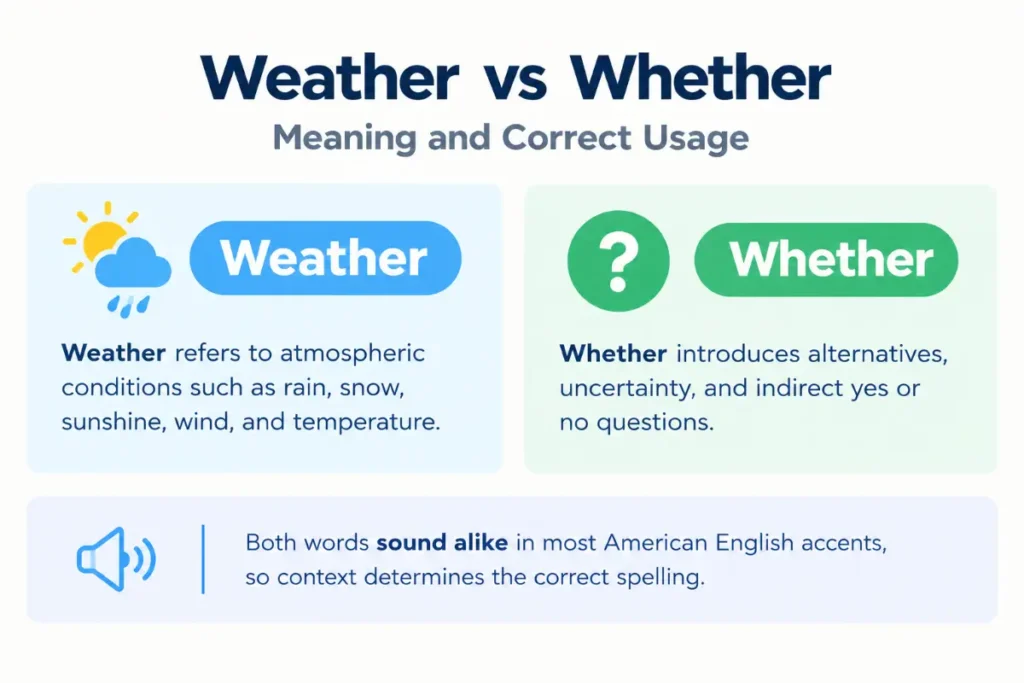
- Weather refers to atmospheric conditions such as rain, snow, sunshine, wind, and temperature.
- Whether introduces alternatives, uncertainty, and indirect yes or no questions.
- Both words sound alike in most American English accents, so context determines the correct spelling.
- Weather can function as both a noun and a verb.
- Whether often appears with words such as decide, know, ask, wonder, and determine.
- Whether or not is a common expression that introduces alternatives or emphasizes an outcome that remains unchanged.
- If can replace whether in many indirect questions, but not in every grammatical construction.
- The quickest memory trick is to associate weather with atmospheric conditions and whether with choices.
Need another quick comparison? Read Prefer Or Perfer Which Spelling Is Correct.
Conclusion
The difference between “weather vs whether” is simple once you connect each spelling with its meaning. Use the atmospheric noun for rain, sunshine, wind, temperature, and other outdoor conditions. Use the conjunction to introduce an indirect question, an uncertain possibility, or a choice. Both are standard English words, so the right spelling depends on the sentence rather than a rule that makes one form incorrect.
For an easy editing check, replace the noun with “atmospheric conditions” or the conjunction with “if” when the sentence allows it. This small habit can prevent a common writing mistake.
FAQs
Are Weather and Whether Homophones?
Yes. They are homophones because they share the same pronunciation in most English accents but have different spellings and meanings. One refers to atmospheric conditions, while the other introduces alternatives or uncertainty. Since they sound alike, you must use the sentence’s meaning and grammar to select the correct spelling.
What Is the Easiest Way to Remember the Difference?
Connect the word beginning with W and ending in R to the idea of weather outside. Think of rain, wind, sunshine, and temperature. The other spelling belongs in sentences about choices and uncertainty, such as deciding whether to stay home or go out. These simple associations make the distinction easier to remember.
Is Whether a Real Word?
Yes. It is a standard English conjunction used to introduce indirect questions, alternatives, and uncertain possibilities. You can use it in sentences such as “I don’t know whether he is ready” and “She must decide whether to accept the offer.” It is not a misspelling of the atmospheric noun.
Can Weather Be Used as a Verb?
Yes. As a verb, it means to withstand a difficult situation or to change because of exposure to the elements. For example, “The family weathered a difficult year” means they survived a challenging period. “The paint has weathered over time” describes gradual change caused by exposure.
Can I Use If Instead of Whether?
Often, yes. In an indirect question, “I don’t know if she is coming” and “I don’t know whether she is coming” have nearly the same meaning. However, the conjunction is especially useful when presenting two alternatives. It is also the more suitable choice in some formal constructions.
Should I Write Weather or Whether in an Email?
Choose the word according to your meaning. Use the atmospheric noun when discussing forecasts, outdoor conditions, travel delays, or events affected by rain and temperature. Use the conjunction when asking for confirmation or discussing a decision. Both forms are appropriate in professional emails when used correctly.
Is Weather or Whether Used in the Phrase Whether or Not?
The correct phrase is “whether or not.” It introduces alternatives or emphasizes that an outcome does not depend on a particular condition. For example, “We will attend whether or not it rains” means the decision to attend will remain the same. The atmospheric noun does not belong in this expression.
Why Do People Confuse These Two Words?
People confuse them because they have the same pronunciation and similar spellings. Speech does not show the difference, and spell checkers may accept both forms. Writers sometimes type the first spelling that comes to mind without checking the sentence. Learning their meanings and common grammar patterns is the best way to avoid this error.