
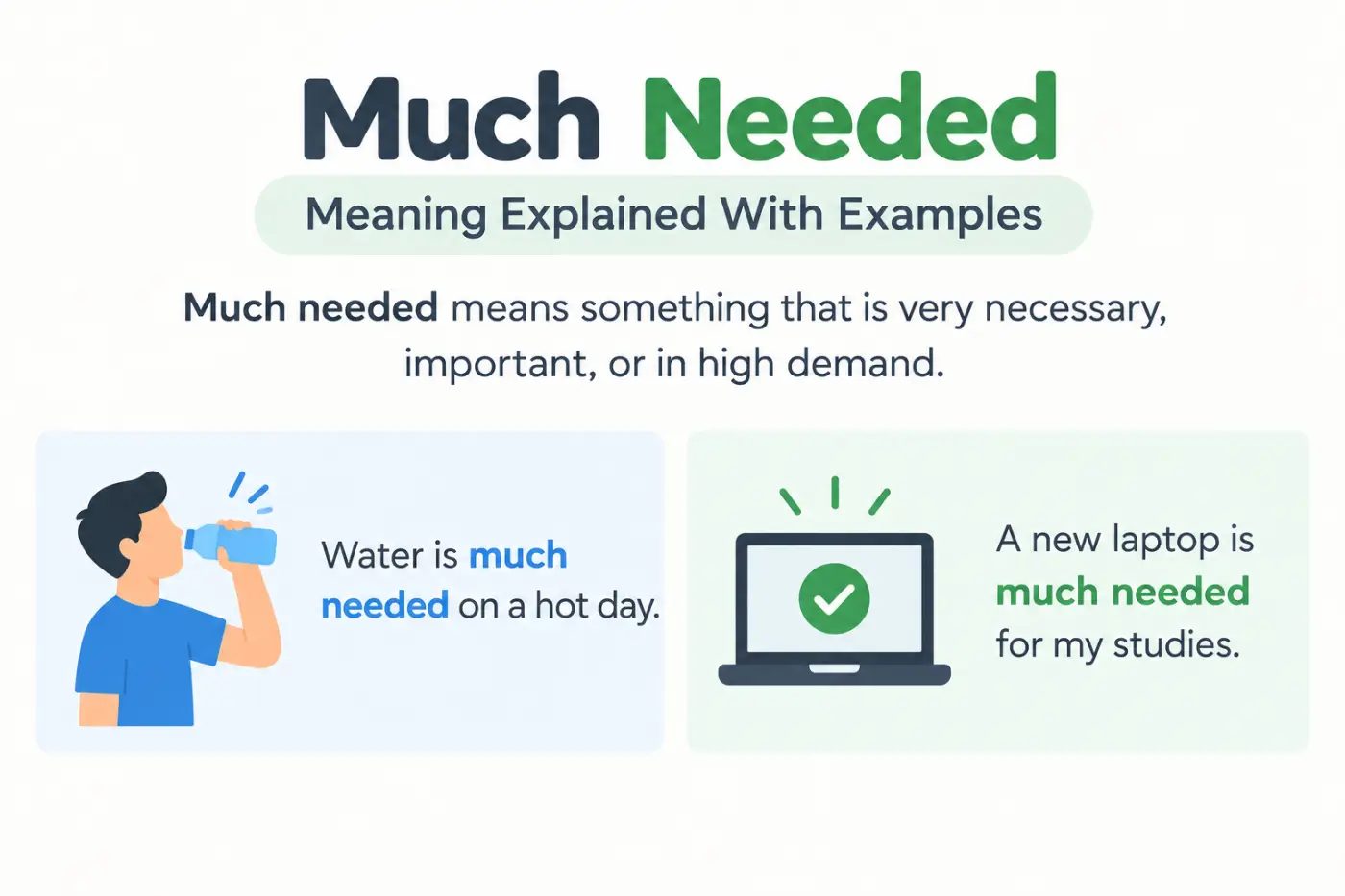
Have you ever heard someone say that they need a much needed break or that a town finally received much needed rain? The phrase much needed meaning can be confusing because the words seem simple, yet their combination adds a stronger sense of need. It tells readers that something is not just useful or welcome. It is especially necessary, often because a person or situation has gone without it for too long.
In everyday American English, people use this expression in conversations, text messages, emails, news reports, school assignments, and workplace discussions. You might describe a weekend off as a much needed rest, call financial help much needed support, or praise a much needed change at work. The phrase works in many settings because it expresses a clear idea without requiring complicated words.
The key is understanding how the phrase functions in a sentence. You will learn its definition, grammar, punctuation, pronunciation, common patterns, and differences from similar expressions. You will also see practical examples that show when it sounds natural and how to avoid common writing mistakes.
A related grammar guide is Please Disregard My Previous Email Meaning and Usage.
Quick Answer
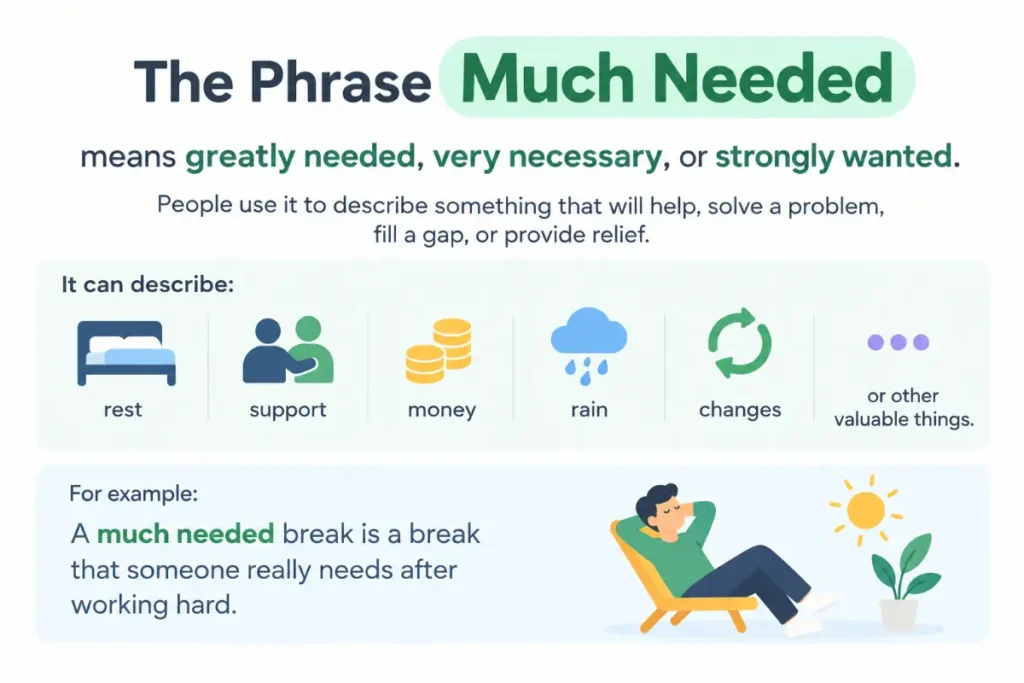
The phrase much needed means greatly needed, very necessary, or strongly wanted. People use it to describe something that will help, solve a problem, fill a gap, or provide relief. For example, a much needed break is a break that someone really needs after working hard. The phrase can describe rest, support, money, rain, changes, or other valuable things.
What Does Much Needed Mean
Much needed means greatly needed or very necessary. It describes something that a person, group, or situation requires or strongly wants. The phrase often suggests that the need is significant and that receiving the thing will bring relief, improvement, or a welcome result.
For example, consider this sentence.
After working twelve days in a row, Maria took a much needed vacation.
The vacation was not simply enjoyable. Maria needed time away from work to rest and recover. The expression emphasizes how valuable that break was.
Here is another example.
The farmers welcomed the much needed rain.
The rain was especially necessary, perhaps because the crops had suffered from dry weather. The phrase highlights the importance of the rainfall.
The expression can describe physical needs, emotional support, practical help, or improvements to a difficult situation. It does not always mean something is required for survival. Sometimes it simply means the thing is overdue or would make life much better.
For example, a much needed conversation might help two friends resolve a disagreement. A much needed update might make a computer program easier to use. A much needed raise might help an employee manage rising expenses.
The central idea stays the same. Something is needed to a considerable degree.
Understanding the Two Words
The phrase combines the adverb much with the past participle needed.
Each word contributes to the meaning.
What Much Means
Much is an adverb in this expression. It strengthens the idea of need by showing its degree.
Compare these sentences.
- The team needed help.
- The team much needed help.
The second sentence emphasizes the strength of the need. The first sentence states that help was required, while the second gives the need greater emphasis.
In the common expression much needed, much modifies needed rather than naming a separate object or action.
What Needed Means
Needed is the past participle of the verb need. It describes something that someone requires or considers necessary.
For example, in the sentence The community needed better roads, needed functions as the main verb in the past tense. In the phrase much needed roads, needed helps describe the roads as something the community greatly requires.
This distinction explains why the phrase can appear before a noun.
Much needed assistance.
Much needed improvements.
In each example, the words describe the noun that follows them.
How the Phrase Works in a Sentence
The expression commonly appears before a noun, but it can also appear after a linking verb or inside a longer sentence.
Before a Noun
This is one of its most common patterns.
- She took a much needed break.
- The city received much needed funding.
- We finally got some much needed sleep.
- The school introduced much needed changes.
In these sentences, the phrase modifies the noun that follows it. It tells the reader why the break, funding, sleep, or changes matter.
After a Linking Verb
The expression can also follow a verb such as is, was, or seems.
- The break was much needed.
- The extra support is much needed.
- The changes were much needed.
- Her advice was much needed.
Here the phrase describes the subject rather than appearing directly before a noun. This structure is especially useful when you want to make the importance of something the main point of the sentence.
In Longer Sentences
The expression can fit naturally into more detailed writing.
After months of staff shortages, the hospital received much needed funding to improve patient services.
The funding was much needed because the hospital had been struggling with a specific problem. The extra detail explains the reason behind the strong need.
Similarly, a teacher might write that students need much needed support during a difficult school year. However, this wording is repetitive because need and needed express closely related ideas. A cleaner version would be Students need support during a difficult school year or Students received much needed support during a difficult school year.
Good writing depends on the whole sentence, not just the phrase itself.
Is Much Needed One Word or Two Words
Much needed is written as two words. It is not normally combined into a single word.
The spelling follows the roles of the two words. Much acts as an adverb, and needed comes from the verb need. Together, they form a phrase that describes a strong degree of need.
Correct forms include the following.
- Much needed help.
- Much needed rest.
- Much needed changes.
- Much needed attention.
Writing muchneeded as one word is not standard English.
There is another detail to remember. When the expression appears before a noun, writers often use a hyphen between the words to make the compound modifier easier to read. That form is much needed in some editing styles, but the choice depends on the sentence and the style guide.
For example, many editors prefer a much needed break or a much needed improvement in informal writing. Others prefer a much needed break without a hyphen because the meaning is already clear. In more carefully edited prose, much needed may be hyphenated before a noun when the writer wants to show that the two words work together as one modifier.
The important point is that the expression remains two words, even when a hyphen connects them.
Should Much Needed Be Hyphenated
The phrase can be written with or without a hyphen depending on its position, the intended reading, and the style guide being followed.
Before a Noun
When the phrase comes directly before a noun, it functions as a compound modifier.
Examples include:
- A much needed break.
- Much needed financial support.
- A much needed policy change.
- Much needed medical supplies.
Some editors hyphenate the expression in this position to make the connection clear. Others leave it open because the meaning is easy to understand.
A hyphenated version may look like this.
The team took a much needed break.
The team took a much needed break is common in everyday writing, while some formal editing styles may prefer a hyphen in the compound modifier. Follow the style guide required by your workplace, school, or publication.
After a Verb
When the phrase appears after a linking verb, a hyphen is generally unnecessary.
Examples include:
- The break was much needed.
- The additional funding is much needed.
- Her advice was much needed.
- The reforms were much needed.
In these sentences, the phrase describes the subject after the verb. It does not sit directly before the noun as a compound modifier.
A Simple Editing Rule
Use the form required by your style guide. If no style guide applies, choose the spelling that reads naturally and clearly, and use it consistently throughout your document.
Do not assume that the phrase must always contain a hyphen. The open form is widely used and readily understood.
Comparison Table for Much Needed
| Expression | Meaning | Grammar | Example |
|---|---|---|---|
| Much needed | Greatly required or wanted | Adverb plus past participle | We received much needed help. |
| Much-needed | The same meaning with a hyphen joining the modifier | Compound modifier before a noun | We received much-needed help. |
| Greatly needed | Needed to a high degree | Adverb plus past participle | The town greatly needed repairs. |
| Urgently needed | Needed without delay | Adverb plus past participle | The shelter urgently needed supplies. |
| Badly needed | Needed very much | Adverb plus past participle | She badly needed a rest. |
| Long overdue | Expected or needed for a long time | Adjective phrase | The long overdue repairs finally began. |
| Essential | Absolutely necessary for a purpose | Adjective | Clean water is essential. |
The phrases overlap, but they do not always mean exactly the same thing. Much needed emphasizes the strength of the need. Urgently needed adds the idea that action cannot wait. Long overdue emphasizes that something should have happened earlier.
Ten Natural Example Sentences
The following examples show how the expression works in everyday and professional English.
1. After a stressful week, I took a much needed afternoon off.
The expression highlights the value of rest after a demanding period.
2. The garden finally received much needed rain.
The rain was important because the garden needed water.
3. Our team received much needed support from the manager.
The support helped the team deal with a problem or complete its work.
4. She used her vacation to get some much needed sleep.
The phrase suggests that she had not been getting enough rest.
5. The school invested in much needed classroom supplies.
The supplies filled a practical gap in the school’s resources.
6. The city approved much needed repairs to the old bridge.
The repairs were necessary to improve the bridge’s condition or safety.
7. After a difficult conversation, the two friends had a much needed chance to talk honestly.
The opportunity helped them address an issue that had been troubling them.
8. The company introduced much needed changes to its customer service process.
The changes were valuable because the old process was not working well enough.
9. The patient received much needed assistance during recovery.
The assistance helped the patient manage the recovery process.
10. A quiet evening at home was much needed after the long trip.
The sentence uses the expression after a linking verb. It emphasizes how welcome the quiet evening was.
These examples show that the phrase can describe something physical, emotional, financial, social, or practical.
You may also want to read Puddy or Putty Which Spelling Is Correct in 2026.
Common Mistakes and How to Avoid Them
Although the phrase is simple, several writing problems appear often.
Writing It as One Word
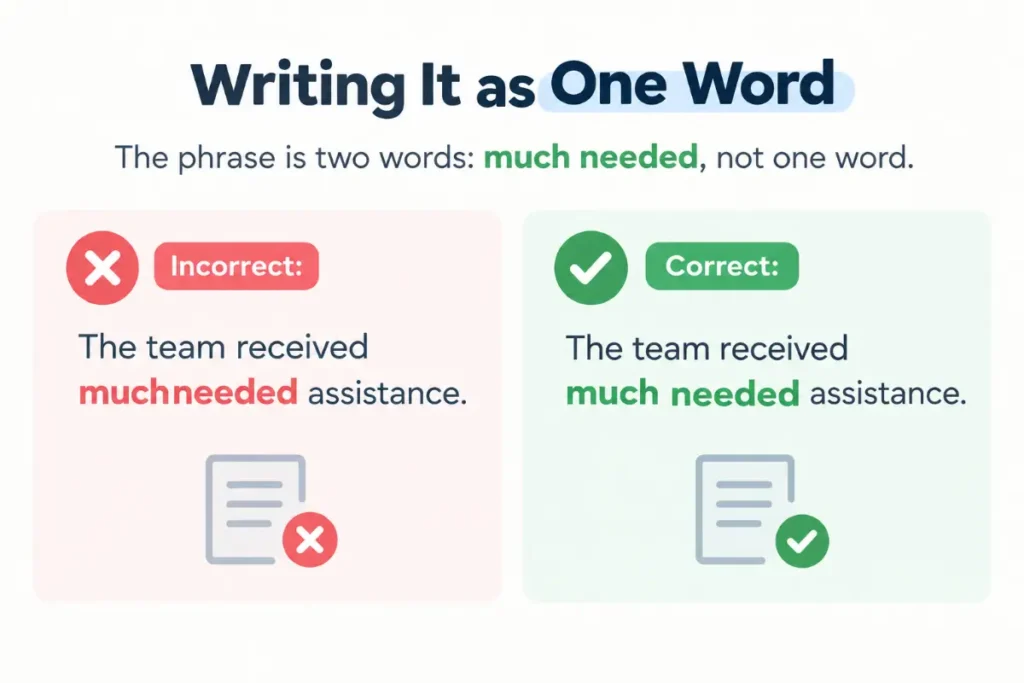
Incorrect: The team received muchneeded assistance.
Correct: The team received much needed assistance.
Much needed consists of two words. A hyphen may join them in a compound modifier, but they do not become one word.
Adding an Unnecessary Extra Word
Awkward: We really much needed a break.
Better: We really needed a break.
Also correct: We much needed a break.
The word really and the adverb much both emphasize the need. Using both in this particular structure can sound unnatural. Choose the version that best fits the sentence.
Using It With a Redundant Verb
Awkward: The staff needed much needed training.
Better: The staff needed training.
Also correct: The staff received much needed training.
The first version repeats the idea of need in a way that makes the sentence clumsy. The second version states the need directly, while the third explains that the training was provided.
Confusing It With Very Needed
Awkward: The community received very needed help.
Better: The community received much needed help.
Very usually modifies adjectives and adverbs, but much needed is the established expression in this context. You could also write greatly needed help or urgently needed help if those phrases fit the intended meaning.
Overusing the Phrase
Repetitive: The project needed much needed funding and much needed support.
Better: The project needed funding and additional support.
Also correct: The project received much needed funding and support.
The phrase is useful, but repeating it can weaken the sentence. Use it once when it adds emphasis, then let the surrounding words carry the rest of the message.
Pronunciation Guide
The expression is straightforward to pronounce in American English.
The word much is pronounced /mʌtʃ/. It rhymes with words such as touch and clutch.
The word needed is pronounced /ˈniː.dɪd/. It has two syllables, with the stress on the first syllable.
Together, the expression has four syllables in ordinary speech.
Much needed.
The strongest stress generally falls on the first syllable of needed, although sentence stress may shift depending on what the speaker wants to emphasize.
For example, in the sentence I really needed a break, the speaker might stress needed to show how strong the need was. In the phrase a much needed break, the emphasis may fall on much or needed depending on the speaker’s tone.
A common pronunciation mistake is to reduce the ending of needed too much or leave out the second syllable. Say the full word clearly, especially in formal speech or presentations.
Etymology and Word Origin
The expression combines two established English words rather than forming a separate word with its own distinct historical origin.
Much comes from Old English and has long been used to express a large amount or degree. Needed comes from need, a word with roots in Old English that has been used to express necessity, lack, or a requirement.
Over time, English speakers have combined adverbs with participles to describe the degree of an action or condition. Much needed follows this familiar pattern. It communicates that the need is strong without changing the basic meaning of the word needed.
The phrase is not limited to one field or a specialized form of English. It works in everyday speech, workplace writing, journalism, and general nonfiction because the meaning is easy to understand from context.
Regional Usage
American English
The expression is standard in American English. People commonly use it to describe a break, vacation, raise, change, repair, improvement, or form of support.
For example, an American employee might say, I could use a much needed day off. A news report might describe a town receiving much needed rainfall after a dry summer.
Both examples sound natural in the United States.
British English
British English also uses the phrase with the same basic meaning. There is no major difference in its definition or grammatical role.
Writers in the UK may follow different editorial conventions for hyphenation, but the underlying expression remains the same.
Canadian English
Canadian English uses the expression in the same way. A writer might refer to much needed funding for public services or a much needed break after a demanding week.
Australian English
Australian English also uses the phrase naturally. The meaning does not change, although individual publications may have their own rules for hyphenation.
Across these varieties, the main difference is editorial preference rather than meaning.
Grammar Rules and Sentence Structure
Understanding the grammar helps you use the phrase with confidence.
As a Modifier Before a Noun
The expression can modify a noun directly.
Much needed support.
Much needed information.
In each case, the phrase describes something that is greatly required.
After a Linking Verb
The expression can follow verbs such as is, was, were, and seems.
The rest was much needed.
The funding is much needed.
The changes were much needed.
This structure allows the writer to place greater emphasis on the thing that was needed.
With Countable and Uncountable Nouns
The expression works with both countable and uncountable nouns.
Countable examples include a much needed break, a much needed change, and much needed improvements.
Uncountable examples include much needed support, much needed information, and much needed funding.
The noun determines the surrounding grammar. The phrase itself does not change simply because the noun is countable or uncountable.
With Articles
When a singular countable noun follows the phrase, an article is normally needed.
Correct: She took a much needed break.
Correct: He received a much needed opportunity.
With plural or uncountable nouns, an article may not be necessary.
Correct: The school received much needed supplies.
Correct: We received much needed information.
The phrase follows the usual rules for the noun it modifies.
Real Life Usage Examples
Daily Conversation
People often use the phrase when talking about rest or relief.
I need a much needed weekend away from work.
After cleaning the whole house, she enjoyed some much needed rest.
In casual conversation, the expression often conveys relief and satisfaction. It can suggest that the speaker has been waiting for something for a long time.
Email and Workplace Communication
The phrase also works in professional messages.
Thank you for providing the much needed information before the deadline.
The department has received much needed funding to complete the project.
In these examples, the phrase explains why the information or funding matters. However, professional writers should avoid using it as empty praise. If the item was not truly necessary, a simpler description may be more accurate.
Academic Writing
In academic work, the expression can describe resources or changes that address a clear need.
The research team received much needed funding to expand its study.
The updated curriculum includes much needed changes to the assessment process.
For highly formal academic writing, greatly needed, essential, or necessary may sometimes be more precise. The best choice depends on the evidence and the point being made.
News and Journalism
Journalists use the expression to highlight something that responds to a community need.
Residents welcomed much needed rain after several weeks of dry weather.
The new clinic will provide much needed care to families in the area.
The phrase gives readers a quick sense of why the development matters. Still, good reporting should explain the underlying need rather than rely on the phrase alone.
Literature and Storytelling
Writers may use the expression to show a character’s relief or the importance of a turning point.
After days of worry, Daniel received much needed reassurance from his sister.
The village celebrated the arrival of much needed supplies after the storm.
The wording helps readers understand the emotional or practical value of what happens next.
Eight Related Words and Expressions
Several alternatives can express a similar idea. The best choice depends on the kind of need you want to describe.
Greatly Needed
Greatly needed means required to a high degree. It is a close alternative when you want a direct and fairly neutral expression.
Example: The school greatly needed additional computers.
Urgently Needed
Urgently needed means required without delay. It adds a sense of immediate importance.
Example: The shelter urgently needed clean water.
Use it when timing matters, not just the strength of the need.
Badly Needed
Badly needed is a common expression meaning very much needed. It sounds natural in everyday American English.
Example: I badly needed a break after the final exam.
Essential
Essential means absolutely necessary for a particular purpose.
Example: Clean drinking water is essential for health.
This word is stronger and more precise when something cannot be done properly without it.
Necessary
Necessary means required or needed.
Example: The manager made the necessary changes.
It is a useful alternative in formal writing because it states the requirement directly.
Overdue
Overdue describes something that should have happened earlier or is late.
Example: The building finally received its overdue repairs.
It emphasizes delay rather than the degree of need.
Welcome
Welcome describes something that is pleasing or gladly received.
Example: The extra help was a welcome change.
Something can be welcome without being necessary, so this word is not always an exact substitute.
Timely
Timely means happening at a useful or suitable time.
Example: Her advice was timely and helpful.
Use this word when the timing makes the help valuable.
Expert Editor Insight
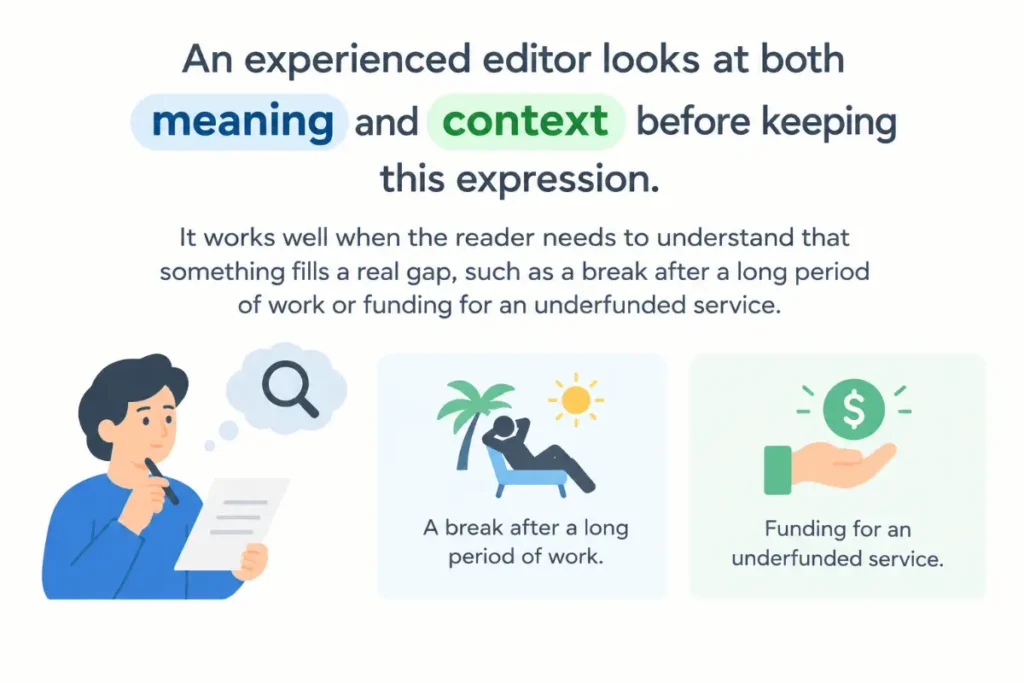
An experienced editor looks at both meaning and context before keeping this expression. It works well when the reader needs to understand that something fills a real gap, such as a break after a long period of work or funding for an underfunded service. It becomes weaker when writers use it simply to make ordinary things sound important. Editors also check for repetition, awkward combinations such as really much needed, and consistent hyphenation. Spelling and grammar tools may suggest changes based on a chosen style guide, but a tool’s preference does not always mean the open form is wrong. Read the full sentence and choose the wording that communicates the intended meaning most clearly.
Learn the difference in Busing or Bussing Grammar Rules and Usage Guide 2026.
Conclusion
Much needed means greatly needed, very necessary, or strongly wanted. It is a useful expression for describing something that fills a gap, brings relief, or addresses an important need. You can use it for rest, support, funding, repairs, advice, and many other things in everyday and professional English.
The phrase is written as two words, although a hyphen may be used before a noun depending on your style guide. To remember its meaning, think of something that is not merely helpful but genuinely needed. When editing, check that the phrase adds real meaning rather than repeating an idea already expressed elsewhere.
FAQs
What does much needed mean in simple English?
It means greatly needed or very necessary. People use it when something is especially useful, important, or overdue. For example, a much needed break is a break someone really needs after a tiring period. The phrase often suggests relief because the person or situation has gone without the needed thing for some time.
Is much needed one word or two words?
It is written as two words. Much is an adverb, and needed is the past participle of need. Some style guides recommend a hyphen when the phrase works as a compound modifier before a noun, but the expression is not normally written as one word. Follow your publication’s style guide for consistent punctuation.
Should much needed have a hyphen?
A hyphen may be used when the phrase appears before a noun as a compound modifier. For example, some editors prefer much needed break with a hyphen connecting the words. Other styles leave it open. After a linking verb, as in The break was much needed, the open form is generally preferred.
What is a synonym for much needed?
Useful alternatives include greatly needed, urgently needed, badly needed, essential, and necessary. Each has a slightly different meaning. Urgently needed emphasizes time pressure, while essential means something is required for a purpose. Choose the alternative that best describes the need instead of replacing the phrase mechanically.
Can much needed start a sentence?
Yes. The phrase can begin a sentence when it modifies a noun. For example, Much needed funding arrived just before the project deadline. This structure is grammatically acceptable, although the sentence should provide enough context to explain why the funding matters. You can also start with the noun phrase in a longer sentence.
Is much needed formal or informal?
The expression works in both formal and informal English. People use it in conversations and text messages, as well as in workplace emails, news reports, and general writing. In highly technical or academic writing, necessary, essential, or greatly needed may be more precise if the context calls for a specific level of importance.
What is the difference between much needed and urgently needed?
Much needed emphasizes the strength of the need. Urgently needed adds the idea that something is required quickly or without delay. A team might need much needed training to improve its skills, while a hospital might urgently need supplies that are running low. The expressions overlap, but they emphasize different aspects of the situation.
Is much needed grammatically correct?
Yes. It is a standard English expression formed from the adverb much and the past participle needed. It can appear before a noun, as in much needed help, or after a linking verb, as in The help was much needed. The main writing decisions involve sentence structure, natural phrasing, and hyphenation.