
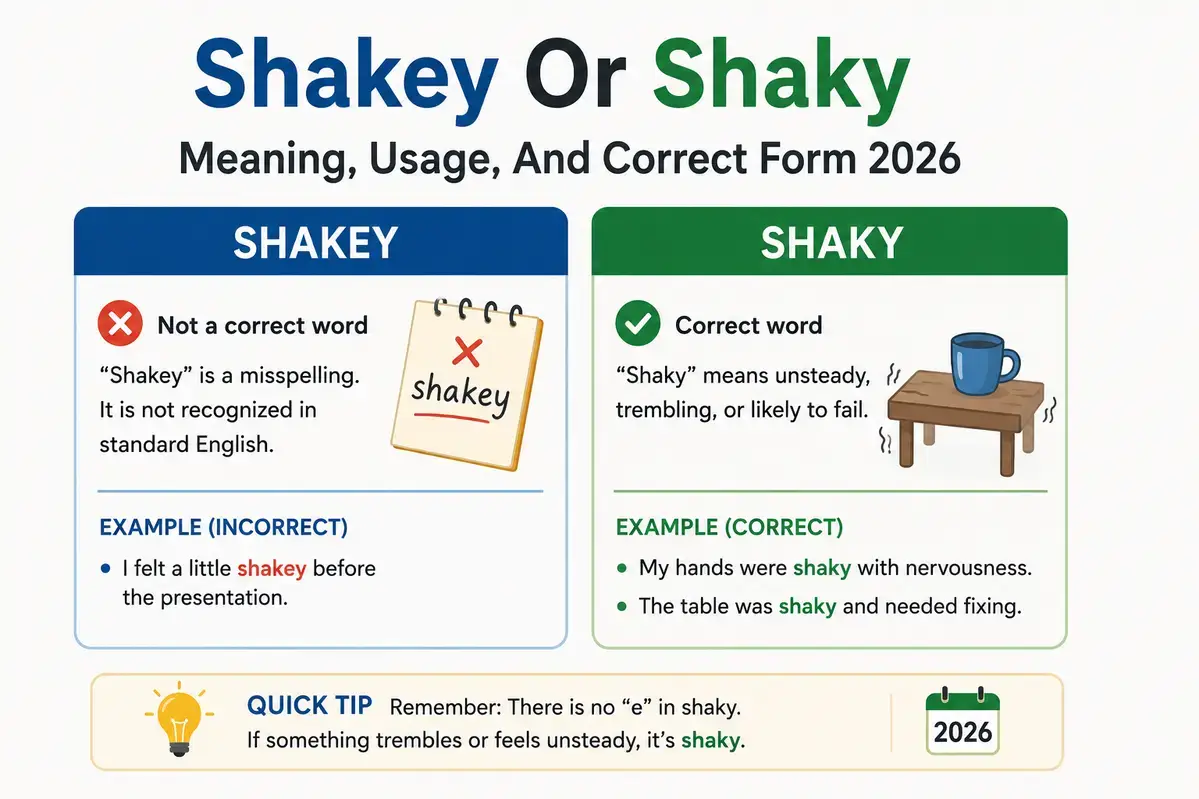
Many English spelling mistakes happen because two words look and sound almost identical. Shakey or Shaky is a common example that causes confusion for students, writers, and even native English speakers. Since both forms are pronounced the same, it’s easy to assume they are equally correct.
The answer is straightforward. Shaky is the standard spelling used in modern English, while shakey is generally limited to proper names, brand names, song titles, nicknames, and other informal uses. Dictionaries, style guides, publishers, and professional editors consistently recommend shaky for everyday writing.
This guide explains why shaky is the accepted form, how the confusion developed, and where each spelling may appear. You’ll also learn the correct pronunciation, grammar, real world examples, common mistakes, and practical tips to help you choose the right spelling with confidence.
You may also want to read Feeling Overwhelmed at Work How to Feel in Control Again.
Shakey Or Shaky Quick Definition
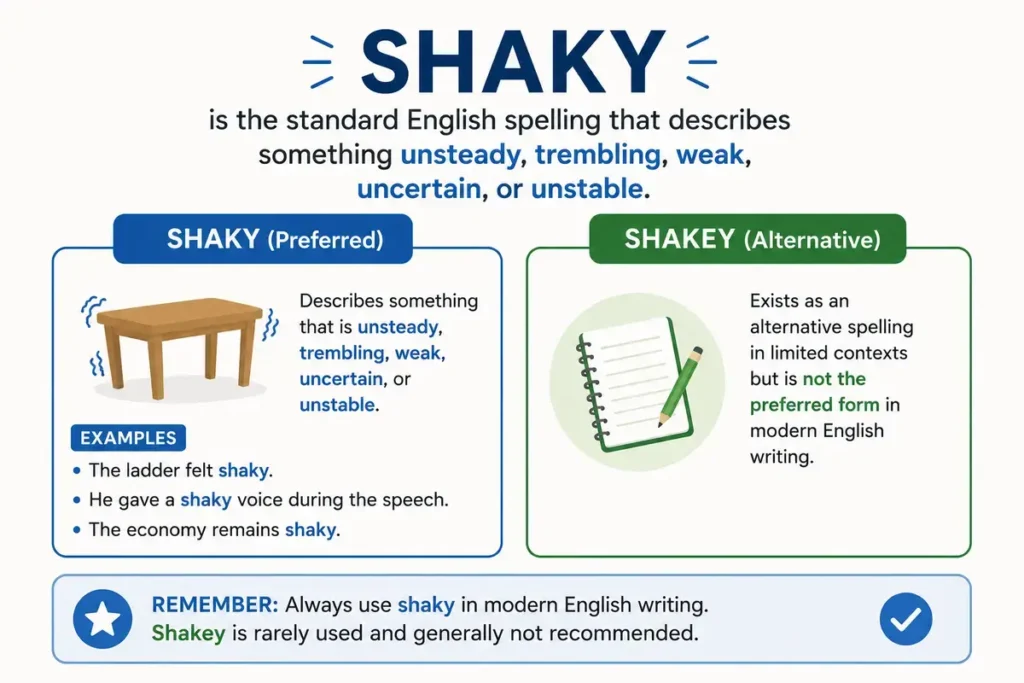
Shaky is the standard English spelling that describes something unsteady, trembling, weak, uncertain, or unstable. Shakey exists as an alternative spelling in limited contexts but is not the preferred form in modern English writing.
Quick Answer
The correct spelling for standard English is shaky. Use shaky when describing something that trembles, lacks stability, is uncertain, or appears weak.
Examples:
- My hands felt shaky after the workout.
- The old bridge looked shaky.
- Her explanation sounded shaky.
Shakey is generally considered a nonstandard or alternative spelling and should usually be avoided in professional writing.
Shakey vs Shaky Comparison Table
| Feature | Shakey | Shaky |
|---|---|---|
| Standard English Spelling | No | Yes |
| Dictionary Preference | Rarely preferred | Widely preferred |
| Part Of Speech | Adjective | Adjective |
| Meaning | Same basic meaning | Unsteady or unstable |
| Usage Frequency | Low | Very high |
| Formal Writing | Usually avoided | Recommended |
| Academic Writing | Rare | Standard |
| Professional Writing | Rare | Standard |
| Modern Publishing | Uncommon | Common |
| Example | Shakey handwriting | Shaky handwriting |
Meaning Of Shakey
Although shakey occasionally appears in English, it is not the dominant spelling.
Definition Of Shakey
Shakey generally carries the same meaning as shaky.
It may describe:
- Something that trembles.
- Something unstable.
- Something uncertain.
- Something weak or unreliable.
Context Of Shakey
You may encounter shakey in:
- Personal blogs.
- Informal online comments.
- Song titles.
- Nicknames.
- Brand names.
- Older publications.
Usage Of Shakey
Examples include:
- His handwriting looked shakey.
- The chair felt shakey.
- She sounded shakey during the interview.
Most editors would revise these examples to use shaky instead.
Meaning Of Shaky
Shaky is the accepted spelling in contemporary English.
Definition Of Shaky
Shaky describes something that lacks steadiness, strength, confidence, or stability.
Common Meanings Of Shaky
The word can describe:
- Physical trembling.
- Weak structures.
- Uncertain plans.
- Poor evidence.
- Nervous emotions.
- Unstable situations.
Context Of Shaky
The word appears regularly in:
- Everyday conversation.
- Journalism.
- Academic writing.
- Literature.
- Professional communication.
- News reporting.
Usage Of Shaky
Examples include:
- The ladder felt shaky.
- His voice sounded shaky.
- Their argument was built on shaky evidence.
- The economy remained shaky.
- She felt shaky after skipping breakfast.
Shakey Or Shaky Meaning Comparison
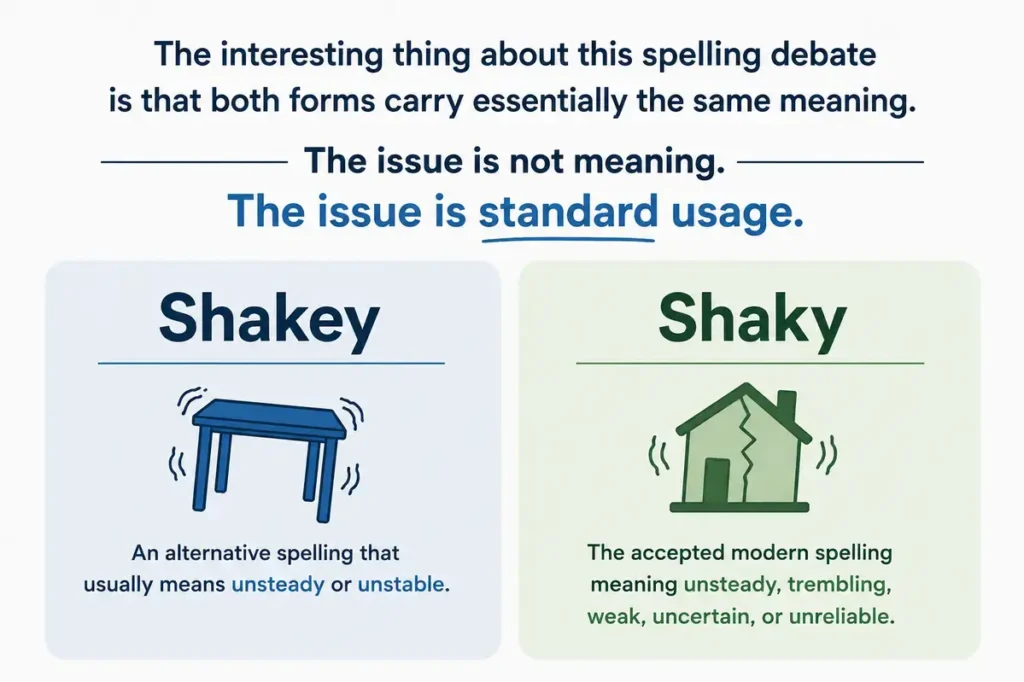
The interesting thing about this spelling debate is that both forms carry essentially the same meaning. The issue is not meaning. The issue is standard usage.
Shakey Meaning
An alternative spelling that usually means unsteady or unstable.
Shaky Meaning
The accepted modern spelling meaning unsteady, trembling, weak, uncertain, or unreliable.
Why People Confuse Them
Several factors contribute to the confusion:
- The words sound identical.
- Both appear online.
- English spelling patterns can be unpredictable.
- Some names and titles use shakey.
- Autocorrect does not always catch the variation.
Shakey vs Shaky Key Differences
The distinction comes down to usage rather than meaning.
Meaning Differences
There is virtually no meaning difference. Both forms express instability or uncertainty.
Spelling Differences
The primary difference is spelling. Shaky is standard. Shakey is nonstandard in most situations.
Professional Usage Differences
Editors, teachers, and publishers prefer shaky. Shakey rarely appears in professionally edited content.
Frequency Differences
Shaky appears far more often in books, newspapers, magazines, and academic publications.
Reader Expectations
Most native English speakers expect to see shaky. When they encounter shakey, many assume it is a typo.
Shakey Or Shaky Which One Is Correct
If you’re writing for school, work, publishing, journalism, blogging, or professional communication, choose shaky. That is the correct and recommended spelling.
Examples:
- The witness gave a shaky statement.
- The bridge looked shaky.
- She felt shaky after the long run.
These examples follow standard English conventions. While shakey is not completely unknown, it is rarely the best choice.
Why Shaky Became The Standard Form
English often preserves certain spelling patterns through long usage and dictionary standardization. Over time, shaky became the accepted form because:
- Major dictionaries adopted it.
- Publishers preferred it.
- Educational systems taught it.
- Style guides recommended it.
- Writers used it consistently.
Once a spelling becomes dominant, alternative forms gradually become less common. That is exactly what happened with shaky.
Shakey Or Shaky In Everyday Language
Native speakers use shaky in several different ways.
Physical Instability
Examples:
- My legs felt shaky after the hike.
- His hands were shaky from exhaustion.
- She stood up on shaky feet.
Emotional Nervousness
Examples:
- He sounded shaky before the presentation.
- Her voice became shaky during the speech.
- I felt shaky before the interview.
Weak Evidence
Examples:
- The claim rests on shaky evidence.
- Their theory seems shaky.
- The report contains shaky conclusions.
Unstable Situations
Examples:
- The economy remains shaky.
- Their relationship is shaky.
- The company’s future looks shaky.
Shakey Or Shaky In Media And Popular Culture
Alternative spellings sometimes survive because of entertainment, branding, or personal preference.
You may find shakey in:
- Music titles.
- Stage names.
- Fictional characters.
- Business names.
- Usernames.
However, these examples do not change the standard spelling used in formal English. A business can choose any spelling it wants. That doesn’t make it the preferred dictionary form.
Shakey Or Shaky In Search Engines
Search data reveals that many people type shakey because they are unsure of the correct spelling.
Common searches include:
- Shakey or shaky.
- Is shakey a word.
- Correct spelling of shaky.
- Shakey meaning.
- Shaky definition.
- Shaky pronunciation.
These searches show that users are primarily looking for spelling guidance rather than meaning clarification.
Shakey or Shaky Synonyms
If you’re looking for alternatives to shaky, several synonyms can express a similar idea, depending on the context. The best choice depends on whether you’re describing physical movement, emotional uncertainty, poor quality, or a lack of stability.
Common synonyms include unsteady, unstable, wobbly, trembling, quivering, weak, fragile, insecure, precarious, uncertain, hesitant, unsure, flimsy, rickety, and unreliable. Each word carries a slightly different nuance, so choose the one that best matches your intended meaning.
Shaky Relationship Meaning
A shaky relationship is a relationship that feels unstable, uncertain, or at risk of falling apart. It often describes a situation where trust, communication, or commitment has weakened, making the future of the relationship unclear.
- Their relationship became shaky after months of constant arguments.
- A lack of trust can leave even a long term relationship feeling shaky.
- Honest communication helped strengthen what had once been a shaky relationship.
A related grammar guide is Plural of quiz Is It Quizzes or Quizzez.
Examples In Sentences
Examples help show how these spellings work in real situations.
Ten Examples Using Shakey
Although this spelling occasionally appears, most editors would replace it with shaky.
- His hands looked shakey after carrying the heavy boxes.
- The old table felt shakey whenever someone leaned on it.
- She gave a shakey explanation during the meeting.
- The ladder seemed shakey from the start.
- His confidence became shakey after the mistake.
- The witness provided a shakey account of events.
- The team’s defense looked shakey throughout the game.
- Her voice sounded shakey during the interview.
- The company’s finances appeared shakey last year.
- The bridge looked shakey after the storm.
Ten Examples Using Shaky
These examples follow standard English usage.
- My legs felt shaky after the marathon.
- The old chair was shaky and unsafe.
- Her voice became shaky during the emotional speech.
- The company’s future looked shaky after the losses.
- His explanation sounded shaky and unconvincing.
- The evidence supporting the claim was shaky.
- I felt shaky after skipping lunch.
- The ladder remained shaky despite the repairs.
- Their relationship seemed shaky for months.
- The economy entered a shaky period of growth.
Common Mistakes
This spelling question causes several recurring errors.
Mistake One
Using shakey in formal writing.
Examples include:
- Academic essays.
- Research papers.
- Professional reports.
- Business communication.
- Published articles.
In these contexts, shaky is the preferred spelling.
Mistake Two
Assuming both spellings are equally accepted. While both forms exist, only shaky is widely recognized as standard modern English.
Mistake Three
Believing shakey is a different word. The two forms generally share the same meaning. The difference is standardization and acceptance.
Mistake Four
Copying informal spellings from social media. Internet content often contains spelling variations that would not pass editorial review.
Mistake Five
Ignoring context. A nickname, brand name, or song title may intentionally use shakey. That does not mean the spelling belongs in formal writing.
Shakey Or Shaky Pronunciation Guide
Pronunciation is one reason people become confused about the spelling. The words sound exactly the same.
IPA Pronunciation
Shaky:
/ˈʃeɪki/
Shakey:
/ˈʃeɪki/
Syllable Breakdown
Sha ky
Two syllables.
Stress Pattern
The primary stress falls on the first syllable.
SHA ky
Common Pronunciation Mistakes
- Adding an extra syllable.
- Stressing the second syllable.
- Pronouncing the first syllable too quickly.
- Confusing shaky with similar sounding words.
Native speakers typically pronounce the word smoothly with strong emphasis on the first syllable.
Etymology And Word Origin
Understanding the history of the word helps explain why one spelling became dominant.
Origin Of Shaky
The adjective shaky developed from the verb shake. The root word shake comes from Old English and has existed in the language for more than a thousand years. As English evolved, speakers created adjectives from verbs to describe conditions or qualities. Shaky emerged to describe something that shakes, trembles, lacks stability, or appears uncertain. Over time, dictionaries standardized the spelling as shaky.
Development Through Modern English
The word gradually expanded beyond physical movement.
It began describing:
- Weak arguments.
- Uncertain situations.
- Fragile relationships.
- Poor financial conditions.
- Nervous emotions.
This broader meaning helped make shaky a common word in everyday English.
Origin Of Shakey
Shakey developed mainly as a spelling variation. It never achieved the same level of dictionary acceptance as shaky. Although it appears in certain names, titles, and informal writing, it remained secondary to the standard form.
Why The Y Ending Won
English contains many adjectives ending in y.
Examples include:
- Funny.
- Sunny.
- Dusty.
- Windy.
- Cloudy.
Shaky followed this common pattern, making it the preferred spelling for editors and publishers.
Regional Usage
One interesting aspect of this spelling comparison is its consistency across English speaking countries.
American English
American English strongly favors shaky. Major dictionaries, newspapers, and educational resources use this spelling.
British English
British English follows the same convention. The preferred spelling is shaky.
Canadian English
Canadian publications overwhelmingly use shaky. The alternative spelling appears only occasionally.
Australian English
Australian English also recognizes shaky as the standard form. Professional and academic writing rarely uses shakey.
Global English
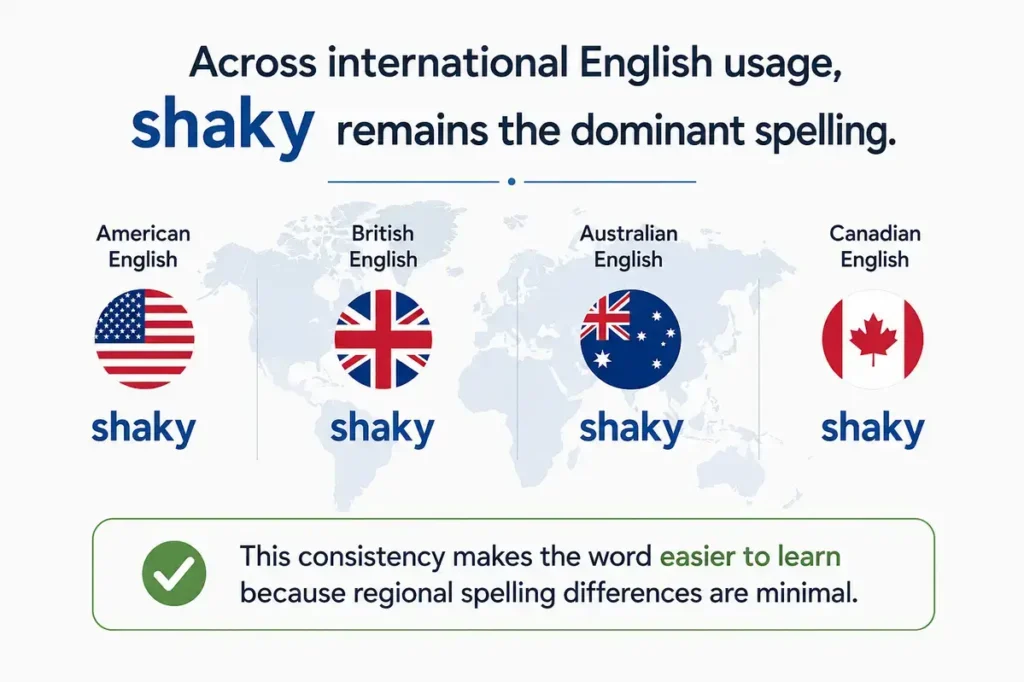
Across international English usage, shaky remains the dominant spelling. This consistency makes the word easier to learn because regional spelling differences are minimal.
Shakey Or Shaky Grammar Rules
Grammar plays an important role in understanding how the word functions.
Part Of Speech
Shaky is primarily an adjective.
Examples:
- The table is shaky.
- Her explanation was shaky.
- The bridge looked shaky.
Attributive Usage
An adjective can appear before a noun.
Examples:
- A shaky ladder.
- A shaky argument.
- A shaky economy.
Predicative Usage
An adjective can also appear after a linking verb.
Examples:
- The ladder is shaky.
- The evidence seems shaky.
- His hands became shaky.
Comparative Form
The comparative form is shakier.
Examples:
- This chair is shakier than the old one.
- The new evidence looks shakier than before.
Superlative Form
The superlative form is shakiest.
Examples:
- That was the shakiest bridge I’ve crossed.
- The company’s performance reached its shakiest point.
Common Sentence Structures
Native speakers often use patterns such as:
- Feel shaky.
- Look shaky.
- Sound shaky.
- Become shaky.
- Remain shaky.
Examples:
- I felt shaky after the workout.
- The argument sounds shaky.
- The structure remains shaky.
Shakey Or Shaky In Professional Writing
Editors almost always choose shaky.
Professional fields that frequently use the word include:
- Journalism.
- Finance.
- Economics.
- Medicine.
- Engineering.
- Education.
- Law.
Examples:
- The market remains shaky.
- The witness appeared shaky under questioning.
- The diagnosis rests on shaky evidence.
Using the standard spelling helps maintain credibility and consistency.
Shakey and Shaky In Modern Communication
The word remains extremely common because it applies to many situations.
People use it to describe:
- Physical weakness.
- Nervousness.
- Unstable structures.
- Weak reasoning.
- Financial uncertainty.
- Fragile relationships.
Its flexibility makes it one of the most useful adjectives for describing instability or lack of confidence.
Shakey Or Shaky Real Life Usage Examples
The best way to understand how native speakers use shaky is to see it in authentic situations.
Daily Conversation
People often use shaky when talking about physical feelings, emotions, or unstable situations.
Examples:
- I felt shaky after standing up too quickly.
- His hands were shaky because he was nervous.
- The table is still shaky even after the repair.
- She looked shaky after the long flight.
- My confidence felt shaky before the interview.
Academic Writing
In academic contexts, shaky usually describes weak evidence, questionable reasoning, or unsupported conclusions.
Examples:
- The hypothesis relies on shaky evidence.
- Researchers criticized the study’s shaky methodology.
- The argument becomes shaky without supporting data.
Professional Communication
Business professionals frequently use shaky when discussing uncertainty or instability.
Examples:
- The company faces a shaky economic outlook.
- Investor confidence remains shaky.
- The proposal rests on shaky assumptions.
- The market entered a shaky period following the announcement.
Literature And Creative Writing
Authors often use shaky to create vivid imagery or emotional depth.
Examples:
- Her shaky hands revealed the fear she tried to hide.
- He crossed the shaky bridge without looking down.
- The old cabin stood on shaky foundations.
Media And Journalism
News organizations commonly use shaky when reporting uncertainty.
Examples:
- The economy showed signs of a shaky recovery.
- The government’s position appeared increasingly shaky.
- Analysts questioned the company’s shaky finances.
Related Words And Confused Terms
Several words share similar meanings with shaky or are frequently confused with it.
Unsteady
Describes something lacking balance or stability.
Example:
The cyclist looked unsteady on the wet road.
Wobbly
Refers to movement that is unstable or shaky.
Example:
The chair felt wobbly after years of use.
Trembling
Describes shaking caused by fear, cold, excitement, or weakness.
Example:
His trembling hands revealed his anxiety.
Uncertain
Refers to doubt or lack of confidence.
Example:
The future remains uncertain.
Fragile
Describes something easily damaged or broken.
Example:
The fragile relationship needed careful attention.
Weak
Suggests a lack of strength, support, or effectiveness.
Example:
The evidence was weak and unconvincing.
Flimsy
Refers to something lacking strength or durability.
Example:
The flimsy structure collapsed during the storm.
Unreliable
Describes something that cannot be trusted consistently.
Example:
The source proved unreliable.
Insecure
Often refers to a lack of confidence or stability.
Example:
He felt insecure about the outcome.
Precarious
Describes something dangerously unstable.
Example:
The workers stood in a precarious position.
Shakey Or Shaky Commonly Confused Search Terms
Users searching for these words often search for related language questions.
Common searches include:
- Shaky meaning.
- Shaky definition.
- Is shakey a word.
- How to spell shaky.
- Shaky pronunciation.
- Shaky synonym.
- Shaky grammar.
- Shaky examples.
- Shaky in a sentence.
- Difference between shakey and shaky.
These searches reveal that spelling accuracy is the dominant search intent behind this topic.
Shakey Or Shaky Expert Language Insight
As an editor, I’ve noticed that spelling variations often survive online far longer than they do in professional writing. Shakey is a perfect example. Many people write it because it looks reasonable. After all, English contains words ending in ey, so the spelling seems plausible at first glance. However, native speakers, editors, publishers, and educators overwhelmingly use shaky. If you submit an article, report, essay, or professional document containing shakey, most editors will change it immediately. That doesn’t mean shakey is completely unknown. It appears in names, titles, brands, and informal content. The difference is that those uses are exceptions rather than the rule. For practical writing, remember this simple guideline: Choose shaky every time unless you’re reproducing a specific name or title that intentionally uses shakey.
In Modern English
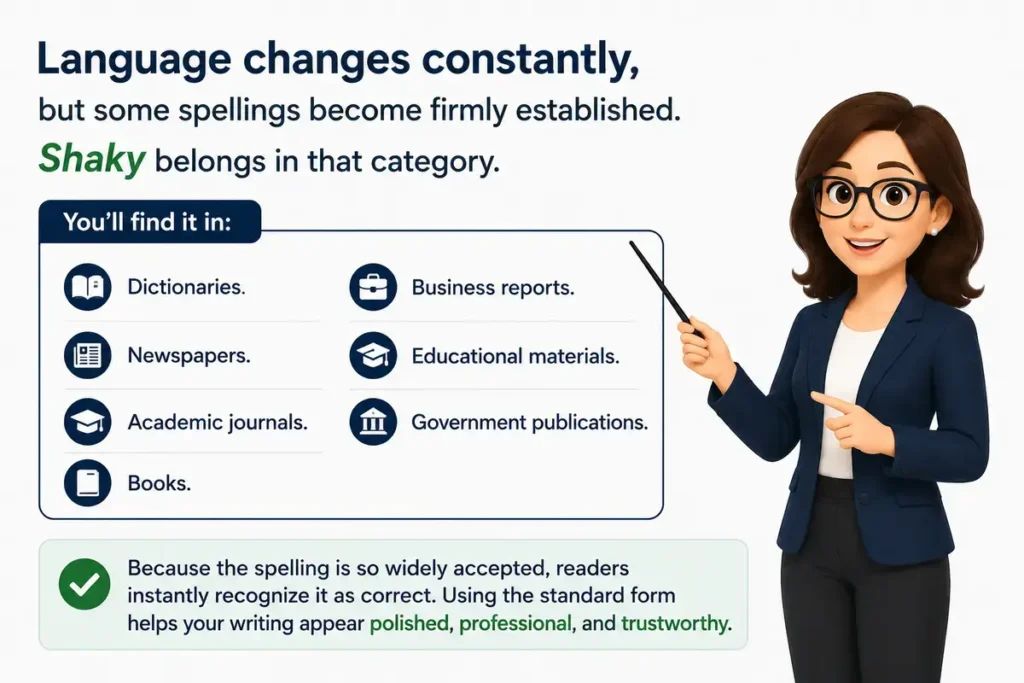
Language changes constantly, but some spellings become firmly established. Shaky belongs in that category.
You’ll find it in:
- Dictionaries.
- Newspapers.
- Academic journals.
- Books.
- Business reports.
- Educational materials.
- Government publications.
Because the spelling is so widely accepted, readers instantly recognize it as correct. Using the standard form helps your writing appear polished, professional, and trustworthy.
Final Verdict On Shakey Or Shaky
The answer is straightforward. Shaky is the correct spelling for standard English. It is recognized by dictionaries, taught in schools, used by publishers, and preferred by professional editors. The word describes something that is unsteady, uncertain, weak, trembling, or unstable. Shakey may appear in certain names, brands, titles, or informal contexts, but it is not the recommended spelling for everyday writing. If your goal is clear, professional, and grammatically accurate communication, choose shaky.
Frequently Asked Questions About Shakey Or Shaky
Is Shakey A Real Word?
Shakey exists as a spelling variation and occasionally appears in names, titles, and informal writing. However, it is not the preferred spelling in standard modern English. Most dictionaries and style guides recommend using shaky.
Is Shaky The Correct Spelling?
Yes. Shaky is the accepted spelling in contemporary English. It appears in dictionaries, educational materials, professional publications, and everyday writing.
Why Do People Spell Shaky As Shakey?
Many people assume the word should follow other ey spelling patterns found in English. Since both spellings sound identical, some writers choose shakey without realizing that shaky is the standard form.
What Does Shaky Mean?
Shaky describes something unsteady, unstable, trembling, weak, uncertain, or unreliable. It can refer to physical objects, emotions, health, finances, evidence, relationships, or situations.
Is Shakey Ever Correct?
Yes. It may be correct when used as part of a proper name, nickname, song title, business name, or other intentional spelling choice. Outside those contexts, shaky is usually the better option.
How Do You Pronounce Shaky?
Shaky is pronounced /ˈʃeɪki/.
It contains two syllables:
Sha ky.
The first syllable receives the primary stress.
Do British And American English Use Different Spellings?
No. Both British English and American English overwhelmingly prefer shaky. The same is true for Canadian English and Australian English.
What Is The Difference Between Shakey And Shaky?
The meaning is essentially the same. The difference lies in standard usage. Shaky is the accepted spelling in modern English, while shakey is generally treated as a variant or nonstandard spelling.
A related grammar guide is Using or Useing Which Spelling Is Correct in 2026.
Conclusion Shakey Or Shaky
The question of shakey or shaky is easy to answer once you know the standard spelling rule. Although both forms may appear online, only shaky is accepted in modern English. It is the spelling recognized by dictionaries, style guides, educators, and professional editors.
Shaky is the correct choice whenever you want to describe something that is unstable, trembling, uncertain, or weak. It is used consistently in everyday conversations, academic writing, journalism, and professional communication across all major English varieties.
Choosing shaky helps your writing remain clear, accurate, and credible. When you’re unsure which form to use, remember that shaky is the spelling readers expect and the one trusted by publishers and language experts.