
English has many word pairs that look closely related but behave very differently in a sentence. Loss or lost is one of them. The words come from the same word family yet you can’t simply swap one for the other.
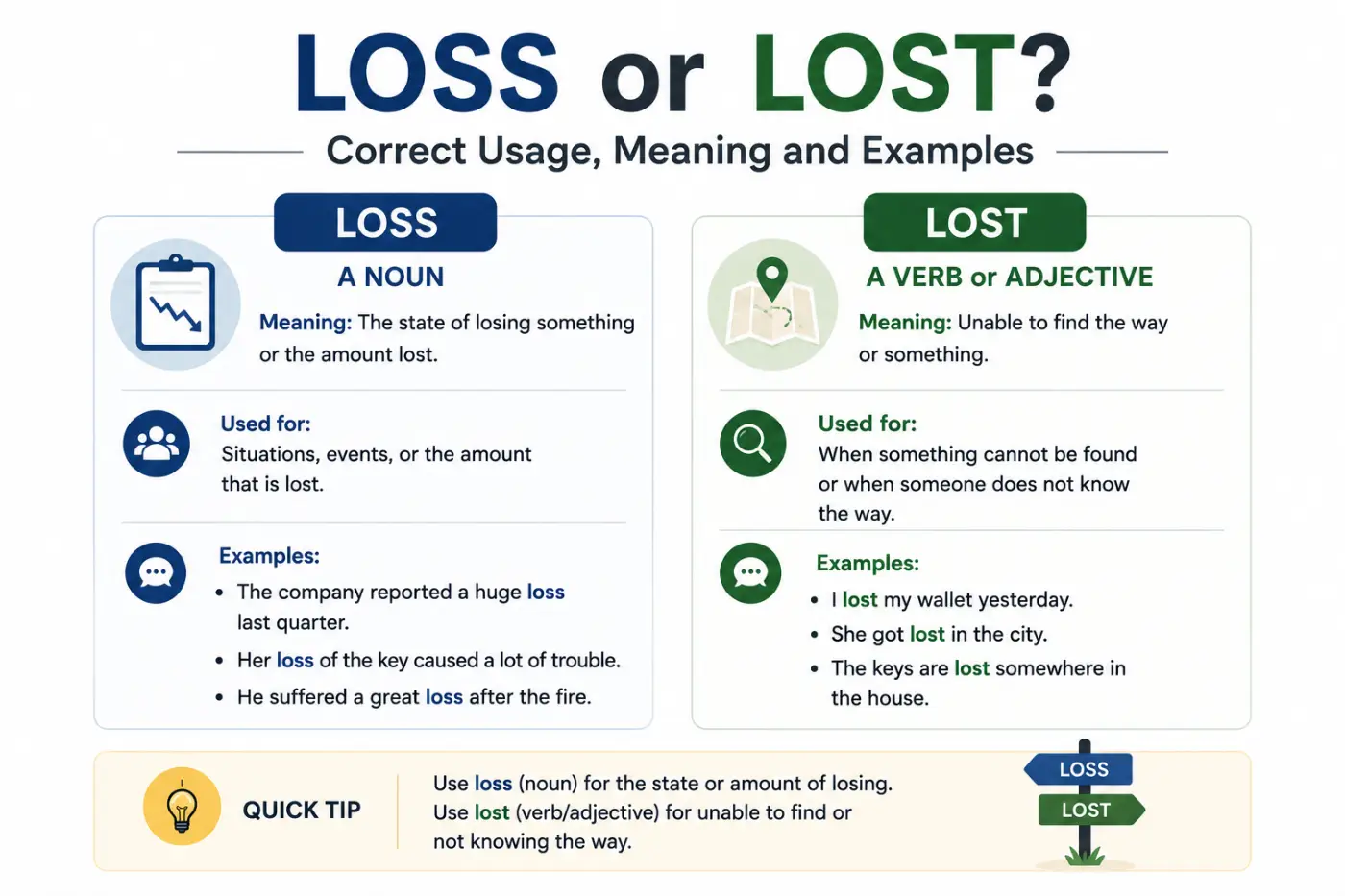
The quick answer is this. Loss is a noun that describes the act or result of losing something. Lost is usually the past tense or past participle of lose and it can also function as an adjective. You can say “The company suffered a major loss” but you can’t replace loss with lost in that sentence.
The confusion makes sense because both words connect to the verb lose. They also appear in many of the same situations involving money people opportunities possessions games and experiences. The forms can sound similar enough to cause mistakes in fast writing.
This guide explains the difference in plain English. You’ll learn the meanings grammar roles pronunciation word history sentence patterns common mistakes regional usage and practical examples. By the end you’ll have a simple way to choose the right form without stopping to second guess yourself.
A related grammar guide is granddad or grandad Correct Spelling Meaning And Usage Guide.
Quick Definition
Loss is a noun meaning the act or result of losing something or someone. Lost is the past tense and past participle of lose and can also be an adjective meaning something is missing or someone cannot find their way.
Quick Answer
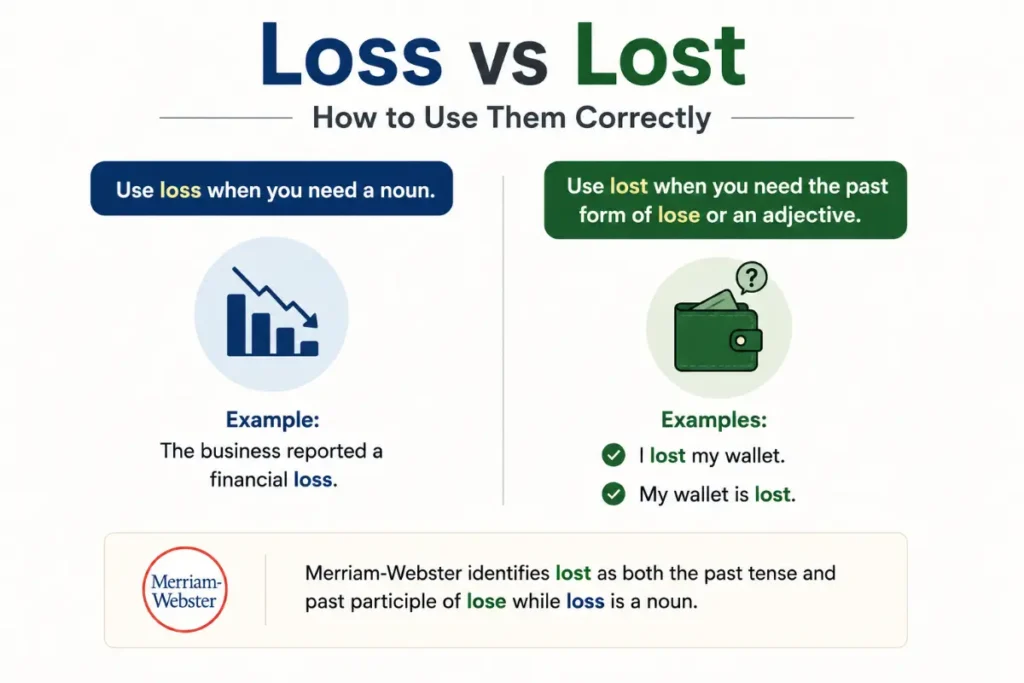
Use loss when you need a noun. For example “The business reported a financial loss.”
Use lost when you need the past form of lose or an adjective. For example “I lost my wallet” or “My wallet is lost.” Merriam Webster identifies lost as both the past tense and past participle of lose while loss is a noun.
Comparison Table Loss or Lost
| Correct Form | Meaning | Part of Speech | Origin | Usage Frequency | Formality | Common Contexts | Example |
|---|---|---|---|---|---|---|---|
| Loss | The act or result of losing something | Noun | Old English and Germanic roots | Very common | Neutral | Money grief health business games | The company reported a loss. |
| Lost | No longer possessed or unable to find a way | Adjective | Past participle of lose | Very common | Neutral | Missing objects directions emotions | My keys are lost. |
| Lost | The past form of lose | Verb | Old English and Germanic roots | Very common | Neutral | Possessions opportunities games time | She lost her phone. |
| Loss | A disadvantage or harmful result | Noun | Related to lose | Very common | Neutral | Business work relationships competition | His departure was a loss to the team. |
| Lost | No longer available or no longer retained | Adjective | Past participle of lose | Very common | Neutral | Opportunities information memories | We lost valuable time. |
| Lost | Confused or unsure | Adjective | Developed from the literal sense of being unable to find the way | Common | Neutral | Conversation work study directions | I felt lost during the discussion. |
| Loss | Financial amount not gained or an amount spent beyond income | Noun | Related to lose | Common | Formal and professional | Finance business accounting | The company recorded a loss. |
| Lost | Defeated or unsuccessful | Verb or adjective | Past form of lose | Common | Neutral | Sports contests competitions | Our team lost the game. |
Meaning and Definition
Meaning of Loss
Loss is a noun. It refers to the act or fact of losing something or to the harmful result that follows from losing it.
Cambridge defines loss as the fact that you no longer have something or have less of something. The word can describe physical things such as money or property. It can also describe less tangible things such as memory opportunity confidence or employment.
Consider these examples.
“Her loss of income created financial pressure.”
“The accident resulted in a loss of control.”
“The death was a painful loss for the family.”
“The company reported a significant loss.”
In each sentence loss names a condition event result or experience. That is the central grammar clue.
A useful test is to ask whether the word can fit after a, the, his, her, their, or the loss of. If it can then you probably need the noun loss.
For example:
“The loss of power caused the system to stop.”
“His loss was difficult for everyone.”
“The business suffered a major loss.”
These structures make the noun role easy to see.
Meaning of Lost
Lost has two major grammar roles.
First it is the past tense and past participle of lose. Merriam Webster lists it directly as the past tense and past participle of lose.
For example:
“I lost my keys.”
“She lost the game.”
“They lost valuable time.”
“We lost the opportunity.”
Second lost can act as an adjective. In this use it can describe something that cannot be found or someone who doesn’t know where to go. Cambridge gives examples involving lost objects people and confused situations.
For example:
“My keys are lost.”
“The child looked lost.”
“I felt lost during the meeting.”
The adjective can also describe something that has disappeared from someone’s possession or something that can no longer be recovered.
That gives you a useful distinction. Loss names the experience or result. Lost describes the state or shows what happened to something.
Key Differences Explained
Spelling
The spelling difference is easy once you connect each word to its grammar role.
Loss has two s letters at the end.
Lost ends with st.
They aren’t alternate spellings of the same word. They are different forms with different grammatical jobs.
Grammar Role
Loss is a noun.
Lost can be a verb form or an adjective.
Compare these sentences.
“The loss was unexpected.”
“She lost the match.”
“The player looked lost.”
The first sentence uses a noun. The second uses a verb. The third uses an adjective.
Meaning
Loss focuses on the experience or result of no longer having something.
Lost focuses on something that has been lost or on the action of losing in the past.
“The loss of the document caused trouble.”
“I lost the document yesterday.”
“The document is lost.”
These sentences describe closely related situations but use different grammatical structures.
Tone
Both words are normal in everyday English. Neither one is especially formal or informal.
Loss appears frequently in business writing academic writing news reports personal writing and formal discussions.
Lost appears everywhere from casual conversation to professional writing.
The correct choice depends on grammar rather than tone.
Context
Context usually gives you the answer.
If you are talking about a result or condition use loss.
If you are describing something as missing or someone as unable to find a way use lost.
Think of the relationship as a simple chain.
Lose → lost → loss
The first word is the base verb. The second is its past form and past participle. The third is a noun related to the act or result of losing.
Which Spelling Is Correct
Both loss and lost are correct words. The real question is which one fits your sentence.
Dictionary evidence makes the distinction clear. Merriam Webster defines loss as a noun and gives meanings connected with being unable to keep something failure to gain something and financial or physical harm.
Merriam Webster also identifies lost as the past tense and past participle of lose and lists adjective meanings such as no longer possessed unable to find the way and lacking confidence.
This is a grammar issue rather than a spelling contest.
Use loss when the sentence needs a noun.
Use lost when the sentence needs the past form of lose or an adjective.
A good editor checks the job the word performs before checking how closely the words look. That approach solves most confusing word problems quickly.
Sentence Examples
Examples Using Loss
- The company suffered a major loss after the storm.
- The loss of her phone caused several problems.
- The team recovered quickly after the loss.
- He struggled with the loss of his job.
- The insurance policy covers financial loss.
Examples Using Lost
- I lost my wallet on the way home.
- She lost the final match by two points.
- We lost an hour waiting for the train.
- They lost their chance to make the final.
- He lost his keys somewhere in the office.
- The child got lost in the crowded market.
- I felt lost during my first week at the new job.
- She has lost interest in the project.
- The letter was lost in the mail.
- Our team lost the championship game.
Common Misspelling Examples
Finaly is a common spelling error in another English word and doesn’t belong in this word pair.
For loss and lost the more common problem involves choosing the wrong form rather than inventing a different spelling.
Here are five incorrect sentence patterns and their corrections.
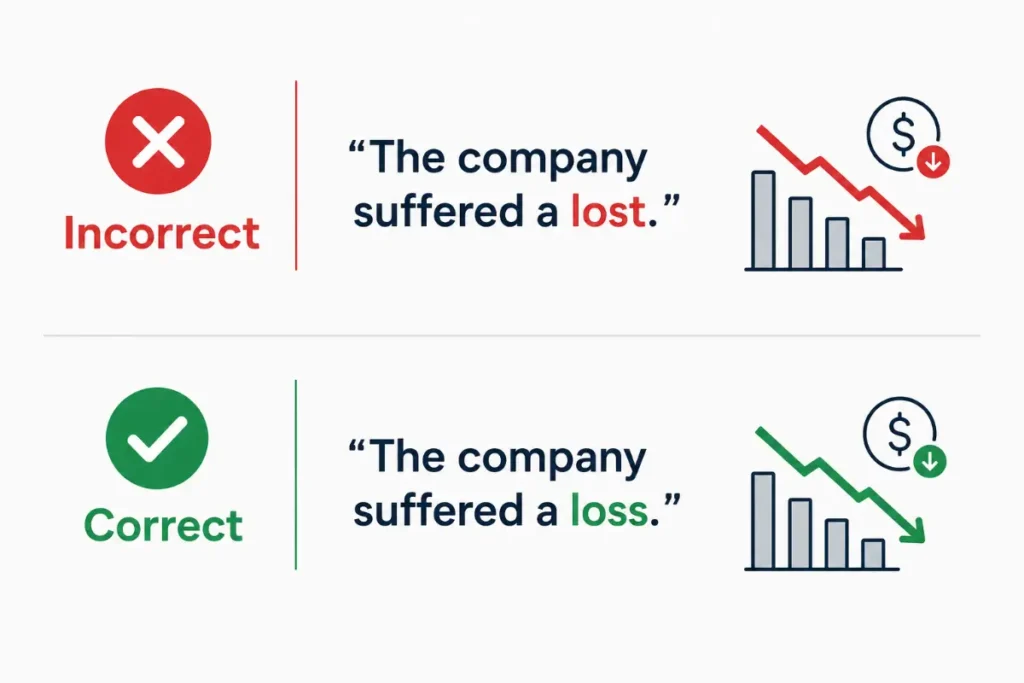
- Incorrect: “The company suffered a lost.”
Correct: “The company suffered a loss.”
- Incorrect: “She experienced a lost of confidence.”
Correct: “She experienced a loss of confidence.”
The mistake usually happens because lose, loss, and lost belong to the same word family. Their meanings overlap but their grammar does not.
Common Mistakes and Misspellings
Using Loss as a Verb
One of the most common errors is writing loss where the sentence needs a past tense verb.
Incorrect: “We loss the game.”
Correct: “We lost the game.”
The reason is simple. The past tense of lose is lost. It isn’t loss.
Using Lost as a Noun
Another mistake is treating lost as the noun for the experience of losing.
Incorrect: “The lost was painful.”
Correct: “The loss was painful.”
The noun is loss.
Confusing Lose and Lost
Lose refers to the base form or present form of the verb.
Lost refers to its past tense and past participle.
“I don’t want to lose my phone.”
“I have lost my phone.”
The tense changes the form.
Confusing Loss and Loose
This is a different spelling trap but it causes plenty of trouble.
Loss means the act or result of losing.
Loose usually means not tight or not firmly attached.
“The loss was unexpected.”
“The screw is loose.”
The words look and sound different but fast typing can blur the distinction.
Choosing by Sound Alone
Native speakers often recognize these words instantly in context. Learners sometimes rely too heavily on sound.
That can create errors because spelling and pronunciation don’t always give you a perfect map of English grammar.
A better strategy is to identify the grammatical role first.
Ask yourself one question.
Am I naming a result or describing an action or state?
If you are naming a result then loss may be right. If you are describing an action that happened then lost may be right.
Pronunciation Guide
The pronunciation difference is useful because it reinforces the spelling difference.
Loss
In US English loss is commonly pronounced /lɔːs/. Cambridge gives the US pronunciation as /lɑːs/ and the UK pronunciation as /lɒs/.
A simple audio style spelling for many American speakers is:
loss
The vowel sounds like the vowel in off for many US speakers.
Lost
In US English lost is commonly pronounced /lɔːst/. Cambridge gives the US form as /lɑːst/ and the UK form as /lɒst/.
A simple audio style spelling is:
lawst
The final t matters.
Syllable Breakdown
Both loss and lost have one syllable.
Loss → one syllable.
Lost → one syllable.
The most noticeable difference is the final sound. Loss ends with an s sound. Lost ends with a t sound after the s.
Don’t add an extra syllable. Neither word needs one.
Many readers also check Busing or Bussing Grammar Rules and Usage Guide 2026.
Etymology and Word Origin
The history of these words explains why they feel so closely connected.
Loss comes from an old Germanic word family connected with losing and destruction. The Online Etymology Dictionary traces the noun to Old English los meaning ruin or destruction and connects it with a Proto Germanic root associated with loosening or separation. The modern meaning developed around the idea of failing to keep or preserve something.
The verb lose also has Old English roots. The Online Etymology Dictionary traces it to Old English losian meaning to be lost or perish and connects it with older Germanic forms.
Lost developed as the past participle of lose. Its use as an adjective later expanded into meanings involving something that is missing ruined unavailable or difficult to recover.
This history gives us a helpful picture.
Lose describes the action.
Lost describes the past action or resulting state.
Loss names the experience or result.
English has preserved these related forms for centuries even though their modern grammar has become highly specialized.
Regional Usage
US English
American English uses loss and lost in the same fundamental grammatical ways as other major varieties of English. US pronunciation can differ from British pronunciation. Cambridge lists loss with a US pronunciation of /lɑːs/ and lost with a US pronunciation of /lɑːst/. There is no standard American spelling that replaces either word.
UK English
British English also uses loss as a noun and lost as the past form of lose and as an adjective. The main noticeable difference can appear in pronunciation. Cambridge lists /lɒs/ for British loss and /lɒst/ for British lost. The grammar remains essentially the same.
Australian English
Australian English follows the same standard distinction.
Writers use loss as a noun and lost as the past form of lose or as an adjective. A sentence such as “The team suffered a loss” works naturally in Australian English just as it does in American and British English.
Canadian English
Canadian English also maintains the standard distinction.
Use loss for the noun and lost for the past form or adjective. Regional pronunciation can vary but the spelling and core grammar remain consistent.
No major English speaking region uses lost as an accepted replacement for the noun loss in standard writing.
Grammar Rules and Part of Speech
Loss as a Noun
Loss is a noun.
It can appear after articles and possessive words.
“The loss was unexpected.”
“A loss can affect the entire team.”
“Her loss of confidence was noticeable.”
It also commonly appears in the structure loss of + noun.
“loss of income”
“loss of opportunity”
This structure appears frequently in professional and academic writing. Cambridge lists examples such as loss of memory job loss hearing loss and other forms involving the reduction or disappearance of something.
Lost as a Verb
As a verb lost is the past tense and past participle of lose.
Simple past:
“I lost my phone.”
“She lost the game.”
“They lost their chance.”
Present perfect:
“I have lost my phone.”
“She has lost interest.”
“They have lost control.”
Past perfect:
“I had lost my keys before I noticed.”
The form stays lost in these perfect constructions.
Lost as an Adjective
Lost can describe a person object opportunity or situation.
“The lost child was found.”
“My lost wallet turned up.”
“He looked lost.”
“She felt lost after the change.”
Merriam Webster includes meanings connected with being unable to find the way being no longer possessed and lacking assurance or confidence.
Punctuation Rules
Neither loss nor lost requires special punctuation.
Punctuation depends on the sentence around the word.
“The loss was unexpected.”
“I lost the document yesterday.”
“The lost document was eventually found.”
The comma belongs only where the sentence structure requires one. The words themselves don’t create a punctuation rule.
Real Life Usage Examples
Daily Talk
- “I lost my keys again.”
This is a normal everyday use of the past tense.
- “The loss of my phone ruined my morning.”
Here loss names the event or result.
- “We apologize for the loss of your account information.”
This uses the noun in a professional context.
- “I lost access to the file after the system update.”
This uses the past tense verb.
Academic Writing
- “The study examines memory loss among older adults.”
The noun identifies a condition or reduction.
- “Participants who lost access to the service reported lower satisfaction.”
The past tense describes an action that happened.
News Writing
- “The company reported a financial loss for the quarter.”
The noun fits financial reporting.
- “The team lost its final match of the season.”
The past tense describes the outcome of a competition.
Literature
- “The character struggles with the loss of his home.”
The noun carries emotional weight.
- “He felt lost after leaving everything behind.”
The adjective describes his emotional state.
These examples show why context matters. The subject may remain the same but the grammar changes depending on what you want to express.
Related and Confused Terms
At Last
At last means something happened after a long wait.
“The bus arrived at last.”
It often carries a feeling of relief.
Eventually
Eventually means something happened after some time or after a series of events.
“She eventually found her keys.”
It focuses on the final outcome after a period of time.
Ultimately
Ultimately means in the final result or after considering the complete situation.
“The decision ultimately benefited the company.”
It often sounds more analytical than at last.
At the End
At the end refers to the final point of a period place event or sequence.
It can be literal or figurative.
Conclusively
Conclusively means in a way that settles an issue with a clear final result.
“The evidence conclusively proved the claim.”
It is more formal than everyday alternatives.
In the End
In the end refers to the final outcome.
It is common in conversational English.
Lastly
Lastly means finally in a sequence of points.
It commonly introduces the final item in a discussion or list.
Missing
Missing means something cannot currently be found or someone is absent.
“My wallet is missing.”
It can overlap with lost but doesn’t always imply that the object was lost through a specific action.
A Simple Memory Trick
If you regularly confuse loss and lost try this shortcut.
Think of loss as the name of the problem.
Think of lost as the action or state.
“The loss was serious.”
“I lost the money.”
“The money is lost.”
The first sentence names the situation. The second tells you what happened. The third describes the resulting state.
You can also connect loss with other nouns such as cost, damage, decline, and reduction.
You can connect lost with verbs such as found, kept, won, and saved.
These mental connections make the distinction easier to recall when you’re writing quickly.
How to Choose the Right Word
When you’re unsure about loss or lost don’t stare at the two spellings. Look at the sentence.
- Ask if you need a noun.
If yes then loss may be correct.
“The loss affected everyone.”
- Ask if you need the past tense of lose.
If yes then use lost.
“She lost her job.”
- Ask if you’re describing something that cannot be found.
Use lost.
“My passport is lost.”
- Ask if you’re describing someone who doesn’t know what to do.
Use lost.
“I felt lost during the first meeting.”
- Look for a loss or the loss.
These structures strongly signal that the noun loss belongs there.
- Look for a subject performing the action.
A sentence such as “He lost his wallet” needs the verb form lost.
This method works better than memorizing isolated definitions because it connects meaning with grammar.
Why This Difference Matters
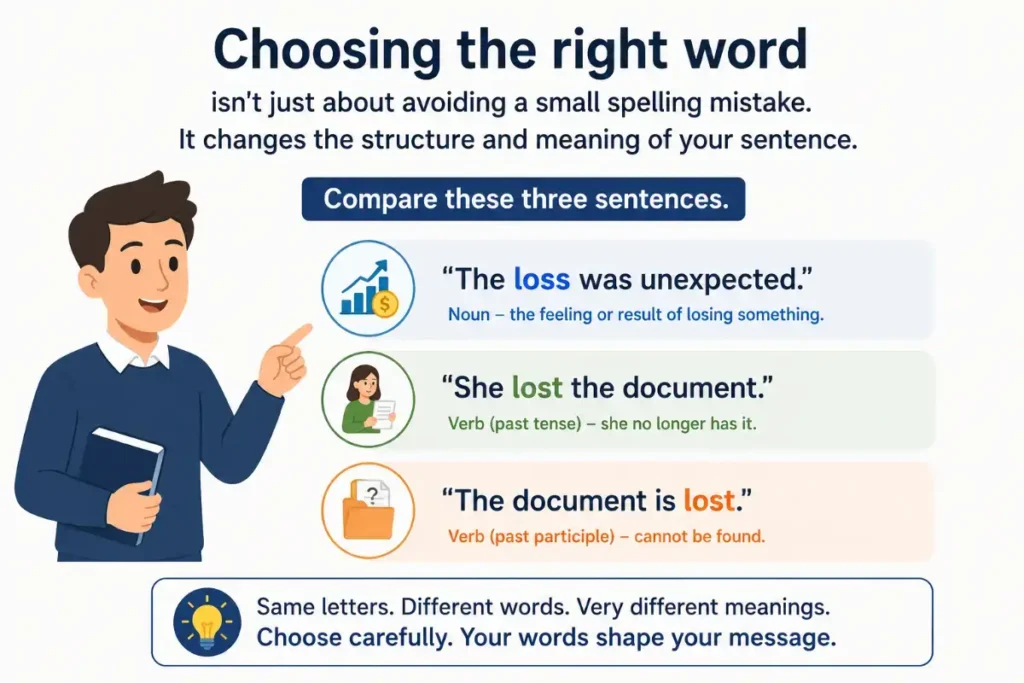
Choosing the right word isn’t just about avoiding a small spelling mistake. It changes the structure and meaning of your sentence.
Compare these three sentences.
“The loss was unexpected.”
“She lost the document.”
“The document is lost.”
The first sentence focuses on the result. The second focuses on the action. The third focuses on the current state.
All three sentences come from the same word family. Yet each one performs a different job.
That pattern appears throughout English. Related words often share a root while serving different grammatical functions. Once you learn to spot the function you can make better choices across many word pairs.
This is also why professional editing focuses on context. A spelling checker may recognize that loss and lost are both valid English words. It may not always understand which one best expresses your intended meaning. Grammar and context have to work together.
Expert Editor Insight
As a senior editor I never choose between loss and lost by examining the words alone. I first consider the role each word needs to play in the sentence. When the sentence names an experience result or condition the noun loss is usually the right choice. When the sentence describes an action that happened in the past lost is the correct verb form. It can also work as an adjective when something is missing or a person feels confused or unable to find direction. Grammar and spelling tools can catch many mistakes by examining nearby words but they can’t fully understand context. A skilled editor considers both the intended meaning and the structure of the entire sentence before making the final choice.
Still confused? Compare Please Disregard My Previous Email Meaning and Usage.
Final Takeaway
The difference between loss or lost becomes simple once you focus on grammar. Loss is a noun that describes the act result or experience of losing something. Lost is the past tense and past participle of lose and it can also act as an adjective for something missing or someone who cannot find their way.
The easiest memory trick is to connect loss with a result and lost with an action or state. When you’re unsure check the role the word plays in your sentence. That small habit can prevent a surprisingly common writing mistake and make your English sound more precise.
FAQs
What is the difference between loss and lost?
Loss is a noun that refers to the act or result of losing something. Lost is usually the past tense or past participle of the verb lose. For example, “The company suffered a financial loss” and “I lost my wallet.”
Is loss a noun or a verb?
Loss is a noun. It describes something that has been lost or the experience of losing something. For example, “The loss of his job was unexpected.”
Is lost a noun or a verb?
Lost is mainly used as the past tense and past participle of lose. It can also work as an adjective. For example, “She lost her keys” uses lost as a verb, while “The lost child was found” uses it as an adjective.
What is the past tense of lose?
The past tense of lose is lost. For example, “I lose my keys sometimes” becomes “I lost my keys yesterday.”
Can loss and lost be used interchangeably?
No. Loss and lost have different grammatical roles. Use loss as a noun and lost as the past tense or past participle of lose, or as an adjective.
Which is correct loss or lost?
Both are correct, but they aren’t used in the same way. Choose loss when you need a noun and lost when you need the past form of lose.